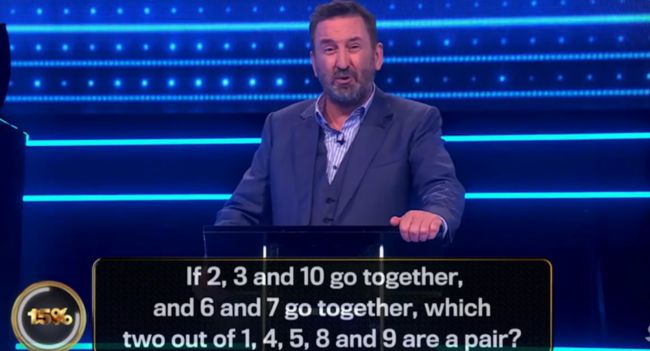
A handful of numbers appeared on the screen, and with only 30 seconds to find the connection, one remaining contestant on The 1% Club saw their hopes disappear.
But the puzzle contained a particularly sneaky trap.
Despite looking like a number problem, solving it required virtually no maths at all.
The 15% question asked:

“If 2 and 3 go together, and 6 and 7 go together, which two out of 1, 4, 5, 8 and 9 are a pair?”
At first glance, the obvious instinct is to start calculating.
Perhaps the pairs are separated by a certain amount. Maybe they produce the same total. There could be an odd-and-even pattern, a multiplication trick or some hidden sequence.
But every second spent searching for a mathematical rule takes you further away from the answer.
Just 30 Seconds To Find The Pair

The ITV quiz tests contestants on logic and common sense rather than traditional general knowledge.
Each episode begins with questions that a large percentage of the public are expected to answer correctly before gradually working toward the notoriously difficult 1% question.
By the time this 15% puzzle appeared in a repeated episode from series two, only a small group of contestants remained.
They were shown the existing pairs — 2 and 3, followed by 6 and 7 — and asked to identify another pair from:
1, 4, 5, 8 and 9.
The clock began.
Thirty seconds later, host Lee Mack revealed that one of the remaining contestants had failed to find the connection and was eliminated.
The reason the puzzle is so effective is simple: the numbers themselves are a distraction.
The Trick Is To Stop Thinking About Numbers

Forget arithmetic.
Instead, write the numbers as words.
Two. Three.
Both begin with the letter T.
Now look at the second pair.
Six. Seven.
Both begin with S.
Suddenly the rule becomes clear.
The numbers are being grouped according to the first letter of their written names.
That leaves:
One
Four
Five
Eight
Nine
Only two of those begin with the same letter.
Four and Five.
Both start with F.
That was the answer Lee revealed.
Once the rule is visible, the puzzle can feel almost ridiculously straightforward. Under a 30-second countdown, however, contestants have to overcome the biggest distraction on the screen: the fact that everything appears to be about numbers.
Six Players Had Already Fallen At 20%

The contestant who went out at 15% was not the first to struggle during the episode.
The previous 20% question had already eliminated six players.
This time, contestants were shown a list beginning with the four-letter words:
SPOT
POTS
TOPS
They were asked to identify the missing four-letter word.
The answer was POST.
Again, the challenge was not specialist knowledge. Contestants needed to manipulate the same letters and recognize another valid arrangement before their time expired.
After six players were eliminated there and another fell at 15%, the field was becoming increasingly thin.
Eventually, only one contestant remained.
Brett Faces The £96,000 Decision
Brett became the sole player to reach the 1% question.
That left him facing the defining decision of the episode.
He already had £1,000 secured and had the option of walking away with an additional £10,000 rather than attempting the final challenge.
Or he could risk it for the entire jackpot.
With £96,000 available and nobody else left to share it with, Brett decided to play the 1% question.
It was a huge opportunity.
But the final puzzle proved one step too far.
Brett answered incorrectly, missing out on the £96,000 jackpot.
The 15% Puzzle Shows Exactly Why The Show Can Be So Difficult
The number-pairing question is a perfect example of how The 1% Club catches contestants without requiring complicated knowledge.
There is no difficult equation.
There is no obscure fact to remember.
There isn’t even any real mathematics involved.
The challenge is recognizing that the obvious interpretation of the question is the wrong one.
See 2, 3, 6 and 7 on a screen and your brain naturally searches for a numerical relationship. The winning move is to ignore their values completely and think about how their names are spelled.
Two and Three. Six and Seven. Four and Five.
Three pairs. Three shared opening letters.
And only 30 seconds to realize it.
One contestant couldn’t make that switch quickly enough — and on The 1% Club, sometimes one tiny letter is all it takes to end the game.