The Mark of Cain: Decoding the Dark Biblical Symbolism Behind Charles and Cathy’s Matching Scars in Netflix’s ‘East of Eden’
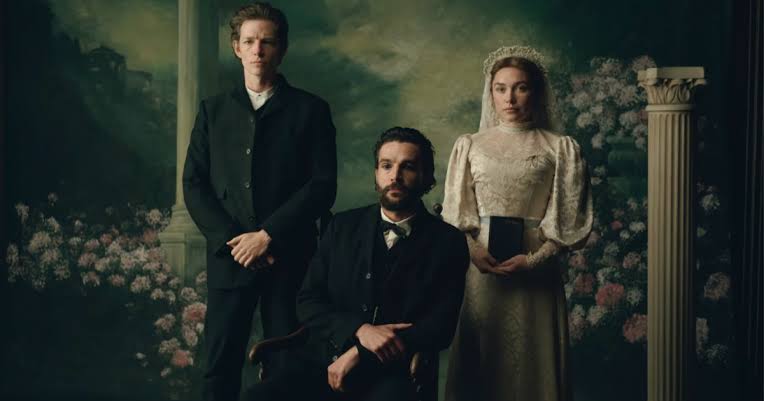
In Netflix’s seven-part limited series adaptation of John Steinbeck’s East of Eden, led by showrunner Zoe Kazan, the shared physical trauma between Charles Trask (Mike Faist) and Cathy Ames (Florence Pugh)—identical forehead scars—serves as the production’s most potent visual shorthand.
While never overtly analyzed in dialogue, the matching disfigurements anchor the adaptation directly to Genesis, serving as a physical manifestation of the Mark of Cain and illuminating why the two characters share an immediate, unsettling psychic kinship that completely bypasses Adam Trask (Christopher Abbott).
Divergent Trauma, Identical Markings
Although their marks are located in the exact same spot—stretching from the hairline down toward the bridge of the brow—they stem from entirely opposite dynamics of violence:
-
Charles’s Self-Inflicted Fury: Loneliness and simmering jealousy after Adam joins the army drive Charles into an uncontrollable rage on the farm. Attacking an immovable boulder with a crowbar, the tool recoils violently and gashes his face. The wound represents internal wrath turned outward, echoing Cain’s explosive resentment toward God and Abel.
-
Cathy’s External Brutality: Cathy acquires her severe facial lacerations following a near-fatal beating by a brothel keeper who abandons her on the road. Crawford crawls to the Trask homestead, where Adam shelters and idealizes her.
When Cathy slips into Charles’s bed on her wedding night to Adam, she deliberately traces the scar on Charles’s forehead before sleeping with him. Charles’s quiet declaration—“Kind recognises kind”—confirms their unspoken recognition: despite differing life experiences, both inhabit the same moral wavelength.
Generational Allegory: The Trask Family Cain & Abel Cycle
Steinbeck structured East of Eden as an iterative reenactment of the fourth chapter of Genesis, utilizing phonetic initials and family rivalries to chart the transmission of inherited trauma:
| Generation | “Cain” Figure (Rejection & Resentment) | “Abel” Figure (Favored & Pure) | The Catalyst of Conflict |
| First Generation | Charles Trask | Adam Trask | Cyrus favors Adam’s stray puppy over Charles’s expensive, hard-earned knife, triggering Charles’s near-fatal assault on Adam. |
| Second Generation | Cal Trask (Joseph Zada) | Aron Trask (Joe Anders) | Adam rejects Cal’s war-profiteering cash gift while celebrating Aron’s academic and moral purity, perpetuating the cycle. |
| The Parallel | Cain (Tiller of the ground) | Abel (Keeper of sheep) | God accepts Abel’s offering of fat portions while rejecting Cain’s produce, inciting humanity’s first murder. |
In this framework, Cathy operates as an external accelerant who carries the exact same spiritual lineage as Charles and Cal, bringing out their destructive instincts while exploiting the naive blindness of the “Abel” figures.
Timshel: The Scars Mark Inheritance, Not Fate
The title East of Eden references the land of Nod, east of Eden, where Cain was banished after receiving a protective mark from God. However, as philosophical conversations between Lee (Hoon Lee) and Samuel Hamilton (Ciarán Hinds) reveal in episodes three and five, Steinbeck rejects strict biological determinism through the Hebrew concept of Timshel (“Thou mayest”).
-
The Predestination Trap: A literal reading would suggest Charles and Cathy are genetically or spiritually condemned to evil, making their matching scars a mark of damnation.
-
The Power of Agency: Timshel frames the mark not as a curse of inevitable ruin, but as a reminder that human beings possess the agency to rule over sin.
While Charles and Cathy surrender to their darkness, the thematic weight of their scars shifts to the next generation: Cal Trask must confront the terrifying reality that he shares his mother and uncle’s dark impulses, while realizing that carrying the “mark” does not rob him of the freedom to choose redemption.