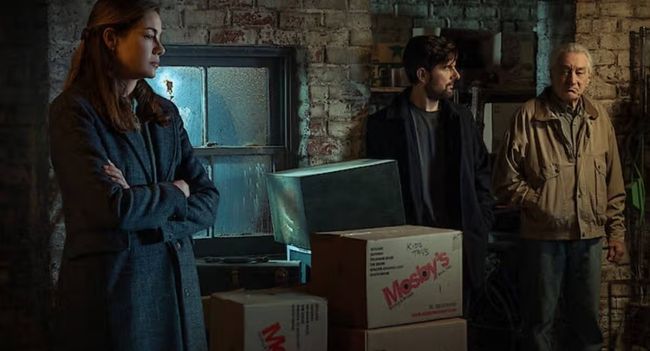
The Whisper Man Ending Explained: The New Killer’s Identity, Pete’s Final Sacrifice and the Haunting Truth Behind Jake’s Imaginary Friend
Major spoilers for The Whisper Man follow.
Netflix’s The Whisper Man spends much of its running time asking an unsettling question: if the notorious child killer Pete Willis caught years ago is still locked away, who has begun repeating his crimes?
The answer is ultimately far more personal than Pete, Tom Kennedy or Detective Amanda Beck initially realize.
The new Whisper Man is Frank Carter Jr., the son of the original killer Frank Carter — a deeply damaged man who has recreated his father’s crimes in a desperate attempt to win the approval he was denied as a child.
But identifying the copycat is only one piece of an ending filled with tragedy. Pete sacrifices himself to save his grandson Jake, Frank Carter delivers one final horrifying act against his own son, and the film’s last revelation suggests Jake’s mysterious imaginary friend may have been connected to his late mother all along.

The Original Whisper Man Is Already Behind Bars
At the beginning of the film’s present-day story, retired detective Pete Willis, played by Robert De Niro, is still haunted by the case that consumed his life.
Years earlier, Pete captured Frank Carter, played by Michael Keaton, the serial killer known as the Whisper Man.
The investigation came at an enormous personal cost. Pete became obsessed with the case, his drinking worsened, and his relationship with his family collapsed. One particularly painful loose end also remained: the body of Carter’s fifth victim, Tony Smith, was never recovered.
Pete’s estranged son Tom, played by Adam Scott, has built a life away from him.
After losing his wife, Tom is raising his eight-year-old son Jake alone. Their relationship is already strained by grief when Jake suddenly disappears.
The circumstances immediately raise terrifying questions.
Someone appears to be using the methods associated with the Whisper Man.
Yet Frank Carter is still imprisoned.
Tom consequently turns to the person he has avoided for 25 years: his father.
Alongside Detective Amanda Beck, played by Michelle Monaghan, Pete and Tom begin trying to understand whether Carter had an accomplice, inspired a copycat or somehow found a way to continue his crimes from prison.

Norman Collins Looks Like the Obvious Suspect
The investigation initially points toward Norman Collins, played by Hamish Linklater.
Norman is obsessed with true crime and has accumulated disturbing murder memorabilia. Tom also discovers him trespassing in the basement of his new home.
Everything about Norman makes him appear capable of being the new Whisper Man.
But his involvement turns out to be stranger than expected.
The major breakthrough comes inside Tom’s house.
Pete and Tom discover human remains hidden in the property — including Tony Smith, the long-missing fifth victim of Frank Carter.
They also find the corpse of Dominic Barnett concealed in the walls.
Suddenly, Jake’s earlier references to a “boy in the floor” take on a horrifying new meaning.
The child had apparently sensed something about the house long before the adults understood what was beneath them.

Why Were the Bodies Hidden in Tom’s House?
Dominic Barnett had previously rented the property and acted as an outside connection to people interested in Carter and his crimes.
Norman eventually admits that he made a deal with the imprisoned killer.
Carter provided information that allowed Norman to reach Tony Smith’s remains. In exchange, Norman connected Carter with someone outside prison.
Norman’s encounter with Barnett then turned violent.
After Barnett mocked him, Norman killed him.
That confession explains the bodies, but it doesn’t solve Jake’s disappearance.
Norman insists he isn’t responsible for kidnapping children. Before Pete and Amanda can extract the final piece of information they need, Norman takes his own life.
He nevertheless leaves them with one crucial clue.
He had helped Frank Carter contact someone on the outside.
The question becomes who Carter wanted to reach badly enough to arrange such a disturbing bargain.
Frank Carter’s Obsession With Pete Contains the Answer
Pete eventually returns to the man he spent years trying to forget.
Carter has remained fixated on the detective who captured him. He has written Pete hundreds of letters from prison, repeatedly taunting him about his broken relationship with Tom.
Tom initially discovers those letters and suspects something sinister.
The truth is different.
Pete kept them as reminders of what the Whisper Man case had cost him — particularly his son.
During their prison conversations, Carter continues exploiting that weakness. But hidden within his manipulation is the clue investigators need.
Who would desperately want to imitate Frank Carter?
Who might have spent years turning him into a myth?
And, crucially, who would Frank himself consider family?
The answer emerges from old footage of an interview involving Carter’s wife and child.
The new Whisper Man isn’t an old accomplice.
He’s Carter’s son.

Frank Carter Jr. Is the New Whisper Man
Frank Carter Jr., played by Owen Teague, is revealed as the person behind the new crimes.
His motivation is rooted in his childhood.
Frank Jr. was himself deeply damaged by his father, making him another victim of Carter long before he became a killer.
Instead of escaping his father’s influence, however, he moves toward it.
Author Alex North explained that Frank Jr. is searching for his father’s approval while simultaneously trying to understand himself through the abuse and trauma that shaped his upbringing.
Director James Ashcroft similarly described his motivation as an attempt to please a father who could never be satisfied.
That makes Frank Jr. both frightening and tragic.
His suffering doesn’t excuse what he does.
But it explains why he reproduces the crimes of the man who traumatized him.
He isn’t merely copying the Whisper Man.
He is trying to become someone his father might finally acknowledge.
Amanda Beck Finds Frank Jr. — And Jake
Once investigators understand the family connection, the race to find Jake accelerates.
Amanda visits the home of the police psychiatrist who interviewed Carter’s family years earlier.
There, she realizes that the young man in the house is Frank Carter Jr.
She also discovers the psychiatrist’s mutilated body inside a barrel.
Jake is there too.
Amanda attempts to rescue him, but Frank Jr. attacks her.
The confrontation becomes a desperate chase through the house before Frank Jr. incapacitates Amanda and escapes with Jake.
Meanwhile, Pete takes another route.
He confronts Frank Carter again.
This time, Pete understands something fundamental about Carter’s killings: beneath the murders was another deeply personal target that Carter could never bring himself to confront directly.
Pete makes a dangerous bargain.
He promises Carter access to his son in exchange for information that could lead them to Jake.
That promise will eventually have devastating consequences.
Pete Makes the Ultimate Sacrifice
Frank Jr. takes Jake back to the place where the mystery has been converging all along: Tom and Jake’s house.
Pete and Tom follow.
Jake is trapped in the same crawlspace connected to Tony Smith’s death, bringing the new Whisper Man’s crime back to the physical remains of his father’s old nightmare.
Pete manages to reach his grandson.
But Frank Jr. attacks him and stabs him in the abdomen with a screwdriver.
Pete knows he is gravely wounded.
Instead of trying to save himself, he uses the time he has left to give Jake a chance.
He tells his grandson to run.
For Ashcroft, Pete’s sacrifice completes the character’s journey.
The original Whisper Man case helped destroy Pete’s relationship with Tom. Decades later, another version of that same nightmare gives him the opportunity to protect Tom’s child.
He cannot undo his failures as a father.
But he can prevent his grandson from becoming another victim.
Pete dies after helping save Jake.
:max_bytes(150000):strip_icc()/Robert-De-Niro-082526-25bc0f96b1514de083fc50e45c7c8c7d.jpg)
Tom Finally Confronts the New Whisper Man
Pete’s sacrifice buys Jake valuable time.
Tom pursues Frank Jr. through the house while Jake hides.
A seemingly minor detail introduced earlier then becomes crucial.
Tom had previously noticed that part of the attic floor was fragile.
During their final confrontation, Frank Jr. falls through that weakened section and crashes below.
The fall incapacitates him, ending his immediate threat and allowing Jake to survive.
Tom finally has his son back.
But their survival has come at the cost of Pete’s life.
The three generations of fathers and sons that have defined the film are now permanently altered.
One family has finally begun breaking its cycle.
Another is about to complete theirs in the darkest possible way.
Frank Carter Finally Gets the Reunion He Wanted
Pete had promised Frank Carter that he would bring him his son.
In a twisted sense, that promise is eventually fulfilled.
Frank Jr. survives his injuries and is brought to prison.
The father and son are finally allowed to meet.
For Frank Jr., this should represent everything he has been pursuing.
His murders were partly driven by his desperate need for his father’s recognition. He followed Carter’s methods, recreated his mythology and transformed himself into a new Whisper Man.
Now he is finally standing before the man whose approval has controlled his life.
But Carter has no loving reunion waiting for him.
Instead, he treats his son exactly as he treated his victims.
Frank covers Frank Jr.’s face with a shirt.
Then he strangles him to death.
It is perhaps the bleakest moment in the film.
Frank Jr. destroys himself trying to earn his father’s love, only for that pursuit to lead him directly into his father’s hands.
Ashcroft told Entertainment Weekly that Carter’s actions reflect his own unresolved trauma and his hatred of the vulnerability he recognizes in his son. The director wanted the moment to remain emotionally complicated rather than provide the simple satisfaction of seeing a villain punished.
Frank Carter’s Story Still Isn’t Over
Frank Jr.’s death doesn’t mean Carter has lost interest in manipulating the people around him.
Pete is dead.
So Carter chooses another target.
He sends a letter to Amanda while she is recovering, thanking her for what she has done.
With Pete gone, the implication is deeply unsettling: Carter appears to have found another police officer on whom to focus his attention.
The gesture reinforces an important aspect of Carter’s character.
Prison may physically contain him.
It hasn’t stopped him from reaching into other people’s lives.
He manipulated Norman.
He influenced his son.
And now his attention appears to have shifted toward Amanda.
The Girl in the Blue Sweater Is the Ending’s Biggest Mystery
The serial-killer mystery is resolved.
Jake’s imaginary friend isn’t.
Throughout the film, Jake repeatedly sees a mysterious young girl wearing a blue sweater.
At first, she appears to be exactly what everyone assumes: an imaginary friend created by a grieving child.
But the final scenes completely reframe her presence.
After Jake has been rescued, Tom looks through old family photographs.
Among them is a photograph of his late wife when she was young.
The girl in the picture looks exactly like Jake’s imaginary friend.
She is even wearing the familiar blue sweater.
The implication is obvious.
Was Jake actually seeing his dead mother?
Was Jake’s Mother Really a Ghost?
The film deliberately refuses to give viewers a definitive answer.
Ashcroft has said the girl must work in two different ways simultaneously: as something that could be explained psychologically and as possible supernatural intervention.
Viewers are therefore free to interpret the revelation either way.
Jake has suffered enormous grief.
His mysterious friend could represent a psychological coping mechanism — his mind creating a protective figure when he desperately needs one.
But the film repeatedly gives the girl knowledge and significance that make a supernatural interpretation difficult to dismiss.
Most importantly, Jake apparently doesn’t consciously know that the girl resembles his mother as a child.
The photograph is discovered by Tom afterward.
North considered preserving this reveal particularly important because it comes directly from his novel and represents what he sees as the emotional heart of the story.
The film therefore leaves the audience with possibility rather than certainty.
Perhaps Jake imagined her.
Perhaps his mother never really left him.
Or perhaps both interpretations can coexist.
Jake Choosing the House May Not Have Been a Coincidence
The supernatural possibility also casts earlier events in a different light.
Jake was drawn to the house Tom eventually bought.
That same property ultimately contains Tony Smith’s remains and becomes central to solving the Whisper Man mystery.
Jake also spoke about the “boy in the floor” before the adults discovered Tony.
De Niro himself raises the question of coincidence in Netflix’s official breakdown of the ending, noting that Jake wanted the house and Tom followed his son’s lead.
If Jake’s mysterious friend truly is some manifestation of his mother, it opens an intriguing possibility.
Perhaps Jake wasn’t randomly drawn toward the house.
Perhaps something was guiding him toward the truth.
Ashcroft deliberately stops short of confirming that interpretation.
That ambiguity is part of the point.
Pete’s “Mister Night” Story Mirrors Jake’s Imaginary Friend
There is another reason the imaginary-friend storyline matters so much.
Tom had one of his own as a child.
He remembered a mysterious figure called “Mister Night,” who would visit him before bed, take him on imaginary adventures and kiss him goodnight.
As an adult, Tom learns the truth.
Mister Night wasn’t imaginary.
It was Pete.
Despite being estranged from his son, Pete had secretly visited Tom at night and read stories to him.
That revelation creates a deliberate parallel with Jake.
Tom believed his mysterious childhood companion wasn’t real, only to discover it was his father.
Jake believes the girl in the blue sweater is his friend, and Tom ultimately discovers that she looks exactly like Jake’s dead mother.
In both generations, a child experiences the presence of a parent through something the adults initially dismiss as imaginary.
That symmetry brings the film’s family story full circle.
The Two Fathers Choose Completely Different Endings
The climax ultimately isn’t only about discovering the new Whisper Man.
It contrasts two fathers.
Pete has made enormous mistakes.
His obsession with Carter damaged his family, and Tom spent decades resenting him.
But when given one final opportunity, Pete chooses his grandson.
He gives his life so Jake can escape.
Frank Carter makes the opposite choice.
His son has spent years destroying himself in pursuit of his approval.
When Frank Jr. finally reaches him, Carter kills him.
One father ends his life protecting the next generation.
The other destroys his own child.
That contrast is central to the film’s larger exploration of inherited trauma and the different ways children respond to damaged parents.
What Does the Ending of The Whisper Man Really Mean?
Despite its serial killers, disappearances and supernatural suggestions, The Whisper Man ultimately closes as a story about what parents leave behind.
Frank Carter passes violence and trauma to his son.
Pete passes pain to Tom, but eventually sacrifices himself to prevent that damage from reaching Jake in the same way.
Tom survives with an opportunity neither Pete nor Frank Jr. truly had: the chance to build a healthier relationship with his own son.
Jake, meanwhile, may have been protected throughout his ordeal by the memory — or perhaps something more than the memory — of his mother.
After Pete’s death, Tom and Jake move into Pete’s home and honor him, finally allowing the fractured relationship between father and son to find some form of reconciliation after it is too late for Pete to experience it himself.
That makes the film’s final photograph more than one last supernatural twist.
Pete is gone.
Jake’s mother is gone.
Yet both continue to shape the family they left behind.
The killers may provide The Whisper Man with its horror, but the final revelation returns the story to its real subject: parents, children and the ways love and trauma can echo from one generation into the next.
*The Whisper Man* on Netflix is streaming now.