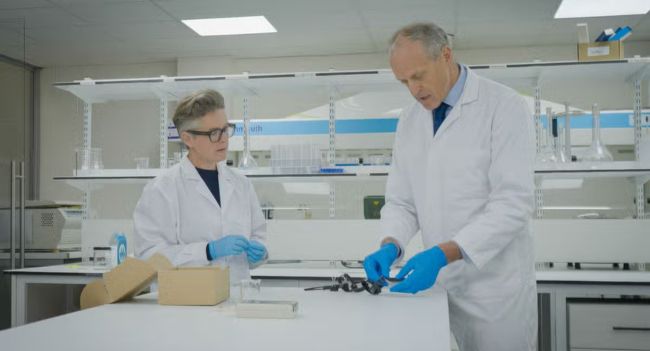
UK Forensic Breakthroughs: The True-Crime Series Putting Forensic Science At The Centre Of Murder Investigations
Forensic science takes centre stage in UK Forensic Breakthroughs, a new 10-part true-crime series examining how tiny pieces of evidence and scientific breakthroughs helped solve real murder cases across Britain.
Presented by Jo Millington, the forensic scientist and long-time forensic adviser to BBC’s Silent Witness, the series premieres on the True Crime channel on Tuesday, September 22, at 10pm. Produced by Monster Films, it explores ten real UK murder investigations in which specialist forensic work played a crucial role in securing convictions.

Jo Millington Puts Forensic Science In The Spotlight
Millington brings more than 30 years of experience in forensic science to the series. Her career has included work with policing, government and private practice, as well as serving as forensic adviser on Silent Witness and several other crime dramas and documentaries.
For UK Forensic Breakthroughs, she takes viewers beyond the familiar police investigation to explore the specialists whose work can often remain behind the scenes.
The series covers a broad range of forensic disciplines, including ballistics, fibre analysis, forensic ecology, fire investigation, forensic archaeology and forensic anthropology.
Millington has said the programme is designed to put forensic science — and the scientists who carry out that work every day — at the heart of the story, rather than leaving it in the background of a conventional crime investigation.
The Murder Case That Opens The Series

The first episode focuses on the murder of Edwin Hiles, who was found dead inside his home in Witney in June 2002.
The investigation became significant because of the use of a pioneering fibre mapping technique. The technique developed by forensic scientist Tiernan Coyle helped link Paul Weedon to the crime.
Rather than simply recounting the murder, the episode examines how the scientific evidence was developed and how investigators used it to connect a suspect to the crime.
It sets the tone for a series built around a simple question: what can forensic evidence reveal when investigators know where to look?
From Fibres To Fire Investigation
Across its ten episodes, UK Forensic Breakthroughs moves through a wide variety of specialist disciplines.
The cases demonstrate how evidence that may appear insignificant at a crime scene can become important when examined scientifically. Fibre analysis, ballistics, fire investigation and forensic ecology all feature alongside more specialised areas of forensic work.
The series also gives access to detectives and forensic experts directly involved in the investigations, allowing them to explain how the evidence was recovered, analysed and ultimately used in the pursuit of justice.
The focus is therefore not only on the crimes themselves, but also on the people whose specialist knowledge helps investigators understand what happened.
A Closer Look At Forensic Archaeology

One of the episodes highlighted by Millington explores the recovery of Natalia Doherty’s body from a clandestine burial site, bringing forensic archaeology and anthropology into focus.
The investigation required painstaking excavation and documentation. Every layer of soil, root system and fragment of evidence had the potential to provide information about how the grave had been created, when it was dug and whether it had been disturbed.
Caroline Sims’ archaeology team worked methodically through the burial site, documenting the structure of the grave, recording the position of the remains and recovering individual items.
The approach turned the burial site itself into a source of evidence, helping investigators understand not only where Natalia had been concealed but also how her body had been hidden.
The Scientists Behind The Evidence
One of the central aims of UK Forensic Breakthroughs is to give greater attention to forensic scientists themselves.
These specialists can spend hours examining microscopic traces, reconstructing scenes or analysing evidence that may initially appear insignificant. Their findings can then become an important part of a much larger criminal investigation.
Millington’s role is to guide viewers through that process while introducing the experts responsible for the scientific breakthroughs featured in each case.
The result is a true-crime format that shifts the focus away from the investigation alone and towards the science that can help establish what happened.
When To Watch UK Forensic Breakthroughs

UK Forensic Breakthroughs premieres on the True Crime channel on Tuesday, September 22, at 10pm, with new episodes airing weekly.
The programme is available through Sky, Virgin Media, Freeview, Freesat and Freely. The TRUE CRIME UK FAST channel can also be streamed through platforms including Prime Video, Rakuten TV, Pluto TV, Plex, LG Channels, Samsung TV Plus, ITVX and 5.
With ten real murder investigations and forensic breakthroughs at its centre, the series offers a detailed look at the scientific work that can turn microscopic clues into evidence capable of changing the course of a case.