BBC’s The Other Bennet Sister Gives Pride and Prejudice’s Forgotten Mary Her Own Love Story — And It Has Become One of 2026’s Most Acclaimed Period Dramas
For more than two centuries, Mary Bennet has stood quietly between the famous sisters of Pride and Prejudice — less romantic than Jane and Elizabeth, less chaotic than Kitty and Lydia, and usually remembered as the awkward middle daughter sitting at the piano while everyone else’s story unfolds around her.
BBC drama The Other Bennet Sister changes all of that.
The ten-part adaptation of Janice Hadlow’s bestselling 2020 novel takes Jane Austen’s overlooked Bennet sister out of the background and makes her the heroine, following Mary as she leaves the suffocating expectations of her family behind and begins discovering friendship, independence and romance for herself.
The gamble has paid off. The series currently holds an impressive 98% critics’ score on Rotten Tomatoes, with a 93% audience score, while The Guardian included it among its best television shows of 2026 so far.
At the center of that success is Ella Bruccoleri, whose portrayal turns a character often treated as a joke or inconvenience into someone viewers desperately want to see find happiness.
Mary Bennet Finally Becomes the Heroine

In Austen’s original Pride and Prejudice, the five Bennet sisters occupy very different positions within their family.
Jane is celebrated for her beauty. Elizabeth possesses the intelligence and wit that make her one of literature’s most enduring heroines. Lydia and Kitty bring youthful chaos and romantic trouble.
Then there is Mary.
Bookish, awkward and uncomfortable in company, she has traditionally existed on the margins of the Bennet family’s story.
The Other Bennet Sister begins with a simple but irresistible idea: what if Mary deserved an epic story too?
The BBC’s original commission described her as anxious, preachy, full of facts, a terrible singer and perpetually overlooked by her mother. Instead of accepting the future others imagine for her, however, Mary eventually begins taking control of her own life.
That transformation provides the emotional engine of the series.
Mary doesn’t suddenly become Elizabeth Bennet.
She learns that she doesn’t need to.
Ella Bruccoleri Makes Mary More Than the “Other” Sister
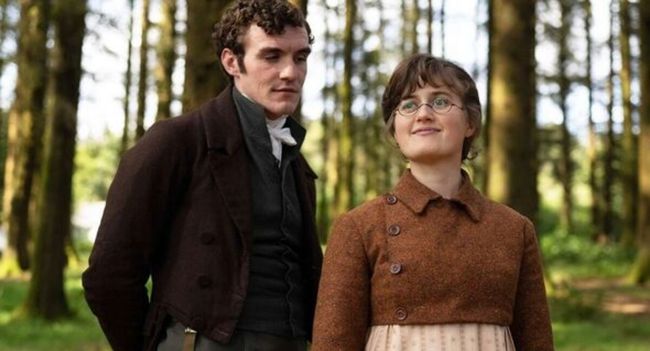
Ella Bruccoleri leads the drama as Mary, surrounded by a large ensemble including Ruth Jones, Richard E. Grant, Indira Varma, Richard Coyle, Dónal Finn and Laurie Davidson.
Bruccoleri’s performance has been one of the most consistently praised aspects of the adaptation.
Even The Guardian‘s initial three-star review, which found some of the early material too slight, described her central performance as “absolutely lovely” and argued that the series gains charm and substance as Mary is finally given room to develop beyond her family.
That development is crucial.
The early story makes Mary’s position painfully clear. She is the sister who doesn’t fit the family’s idea of what a young woman should be.
Her intelligence doesn’t earn her admiration. Her social awkwardness makes her easy to overlook, while her lack of confidence leaves her watching other people’s lives unfold around her.
Once she begins escaping that environment, however, a different Mary starts to emerge.
The Story Expands Far Beyond the Bennet Family Home
Mary’s journey eventually carries her from Meryton into Regency London and onward to the dramatic landscapes of the Lake District.
Bad Wolf, the production company behind the adaptation, describes the series as Mary’s search for independence, romance and — most importantly — acceptance of herself.
That last element separates The Other Bennet Sister from a straightforward Austen-style romance.
There are suitors.
There is romantic tension.
And Mary eventually finds herself facing complicated feelings involving Tom Hayward, played by Dónal Finn, and William Ryder, played by Laurie Davidson.
But finding a husband isn’t presented as the sole solution to Mary’s unhappiness.
Her deeper journey is learning that her value cannot depend entirely on whether her family, society or a potential romantic partner approves of her.
That idea has resonated particularly strongly with viewers who recognize Mary’s experience of being the quiet or awkward person in a family filled with more confident personalities.
Mary Gets the Love Triangle Nobody Expected
Romance nevertheless becomes an important part of Mary’s transformation.
Dónal Finn appears as Tom Hayward, while Laurie Davidson plays William Ryder, giving the previously overlooked Bennet sister romantic possibilities of her own.
But the series takes its time getting there.
Mary must first develop enough confidence to understand what she actually wants rather than simply accepting what other people tell her should make her happy.
Later episodes take her into London society, Pemberley and the Lake District, where her relationships with Ryder and Hayward develop alongside her growing independence.
The final stretch places Mary in increasingly difficult emotional situations, including a journey up Scafell Pike complicated by misunderstanding and a sudden storm.
For a character whose original literary reputation largely revolves around books, sermons and an unfortunate musical performance, it represents quite the transformation.
The Drama Doesn’t Pretend Mary Was Secretly Elizabeth All Along

One of the more interesting decisions in Janice Hadlow’s premise is that Mary’s appeal comes from the qualities that originally made her an outsider.
The story doesn’t need to reveal that she was secretly the most beautiful Bennet sister.
Nor does it transform her overnight into a dazzling social performer.
Instead, Mary gradually becomes more comfortable with herself.
That makes the story an underdog narrative as much as a romance.
BBC Drama director Lindsay Salt described the adaptation that way when the project was first announced, calling it a story filled with heart, wit and charm while offering an original route back into Austen’s world.
Screenwriter Sarah Quintrell similarly described Mary as the “odd one out,” explaining that the drama explores what it means to come of age while feeling that you don’t belong.
That emotional idea gives the series a surprisingly contemporary quality despite its Regency setting.
A Period Drama About Feeling Invisible
The series has also sparked discussion about why Mary’s experience continues to feel recognizable more than 200 years after Austen created the Bennets.
Writing in The Guardian, Rhiannon Lucy Cosslett argued that the adaptation vividly captures the insecurity experienced by clever, bookish young women who feel overlooked or pressured to minimize themselves.
She also noted that Mary’s character arc isn’t solely romantic: her story is equally concerned with independence and learning to accept herself.
That helps explain why the drama has found viewers beyond the obvious audience for Austen adaptations.
At its core, Mary’s predicament is universal.
She believes everyone around her has been given some quality that makes them worthy of attention, while she has been left without one.
The series then spends ten episodes dismantling that belief.
A Cast Filled With Familiar British Television Faces

Bruccoleri may carry the story, but The Other Bennet Sister surrounds her with an impressive ensemble.
Ruth Jones and Richard E. Grant play Mrs and Mr Bennet, while Indira Varma and Richard Coyle appear as Mrs and Mr Gardiner.
Dónal Finn and Laurie Davidson take the major romantic roles of Tom Hayward and William Ryder.
The wider cast also includes Tanya Reynolds as Caroline Bingley, Aaron Gill as John Sparrow and Ryan Sampson as Mr Collins.
Those familiar Austen characters allow the drama to remain connected to Pride and Prejudice while shifting the perspective away from Elizabeth.
The world is recognizable.
The person guiding viewers through it is different.
The Production Comes From the Company Behind His Dark Materials
The series was produced by Cardiff-based Bad Wolf, whose credits include His Dark Materials and Industry.
Sarah Quintrell adapted Hadlow’s novel for television, with Maddie Dai contributing additional writing. Jennifer Sheridan served as lead director, while Asim Abbasi directed later episodes.
The BBC commissioned the production for BBC One and BBC iPlayer, with BritBox co-producing and Sony Pictures Television handling international distribution.
The project was initially ordered as ten 30-minute episodes, providing considerably more space to explore Mary than she receives in Austen’s original novel.
That extra room is essential because the adaptation isn’t simply retelling Pride and Prejudice with Mary standing in Elizabeth’s place.
It is building a life for a character whose original story was largely unwritten.
Critics Have Embraced Mary’s Second Chance

The response has been exceptionally strong.
Rotten Tomatoes currently gives Season 1 a 98% Tomatometer score from 41 critic reviews and a 93% Popcornmeter score from more than 250 audience ratings.
The site’s critics’ consensus describes the series as warm, charming and full of heart, singling out Bruccoleri’s performance and the fresh perspective on Austen’s familiar world.
The Guardian also placed The Other Bennet Sister among its best television programmes of 2026 so far, despite its original review being more reserved about the early episodes.
That combination of critical approval and enthusiastic viewer reaction suggests the show’s appeal extends beyond Austen devotees.
You don’t necessarily need to arrive obsessed with Mr Darcy to become invested in Mary’s story.
Even Unexpected Viewers Have Fallen for It
The original article highlighted one particularly enthusiastic IMDb reviewer who described himself as a 61-year-old “geezer” and admitted that the series was not something he would ordinarily have chosen.
Yet he found himself invested almost immediately.
He praised the settings, costumes and dialogue, but particularly admired the casting and performances across the ensemble, ultimately describing the drama as charming and saying he became deeply invested in Mary’s happiness.
That reaction neatly captures one of the show’s strengths.
Strip away the bonnets, country estates and Regency social rules, and Mary’s central struggle is easy to understand.
She wants to find somewhere she belongs.
And after spending much of her life believing happiness belongs to other people, she has to discover whether she can create it for herself.
The Series Gives Austen’s World a New Center

Retelling Pride and Prejudice is hardly a new idea.
Elizabeth and Darcy have been reinvented repeatedly across film, television and literature.
The Other Bennet Sister finds fresher territory by looking toward someone standing just outside that famous romance.
The approach allows familiar events and characters to appear differently because Mary experiences her family in a completely different way from Elizabeth.
For Lizzy, Mrs Bennet may often be comic.
For Mary, being constantly compared unfavorably with her sisters can be genuinely painful.
That shift in perspective turns what was once background characterization into the foundation for an entire coming-of-age story.
Mary’s Greatest Romance Is With Her Own Future
The series may promise Mary an unexpected love story, but its central message goes beyond which man she ultimately chooses.
Bad Wolf’s official description emphasizes that Mary eventually realizes her happiness lies in her own hands.
That is the destination toward which everything else points.
Meryton shows her what it feels like to be overlooked.
London gives her opportunities to reinvent herself.
The Lake District gives her space to discover a different version of her life.
And her romantic relationships force her to decide whether she is making choices because she genuinely wants them or because she is still desperate for someone else’s approval.
That is what makes Mary’s transformation satisfying.
She doesn’t become the “other Elizabeth Bennet.”
She becomes Mary.
And Mary Bennet’s Story Isn’t Finished Yet
The ten-part first series adapted Hadlow’s novel, but the BBC is already preparing to return to Mary’s world.
As reported in the original article, a three-part Christmas special has been confirmed for later in 2026.
Beyond that, however, a full second series has not been confirmed.
The first season already covers the events of its source novel, meaning any continuation beyond the announced specials would take Mary’s television story into new territory.
For now, viewers have the complete ten-episode journey and another visit to look forward to at Christmas.
That is an impressive outcome for a character who spent generations standing quietly in the middle of one of literature’s most famous families.
Jane and Elizabeth may always be the Bennet sisters readers first remember.
But after The Other Bennet Sister, Mary is considerably harder to overlook.
The Other Bennet Sister is available to watch on BBC iPlayer.