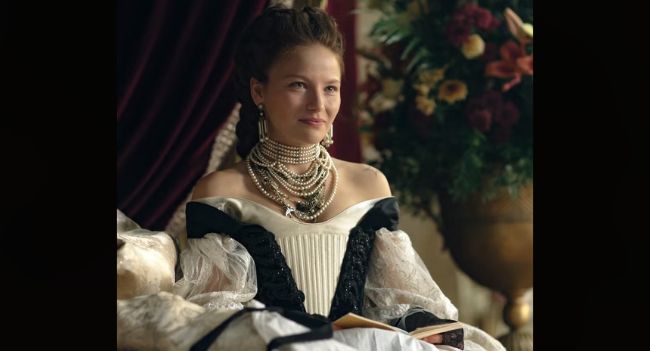
The Series Finale of The Empress, Explained
Empress Elisabeth of Austria secures her greatest political achievement while also gaining a new title: Queen of Hungary.

Netflix
Spoilers for the series finale of The Empress below.
Netflix’s The Empress set out with an ambitious task of covering the life of one of the most idolized royal figures in history. However, and hopefully this didn’t come as a total shock to viewers, the three seasons of the German language production only covered the first half of her life. The series finale ends with the completion of Elisabeth’s most important life’s work: mediating the Austro-Hungarian Compromise power-sharing agreement in 1867. But it ends rather abruptly there, even if it was arguably the last major royal and political action of her life. From there, Elisabeth would go on to spend most of her time traveling around Europe, avoiding the trappings and protocols of the Viennese court. This only increased following the death of her only son, Crown Prince Rudolf, in 1889, through her shocking assassination in Geneva in 1898.
The final episode opens on a very close-up shot of Elisabeth’s most famous portrait, completed by Franz Xaver Winterhalter in 1865. (Of course, the painting onscreen was altered ever-so-slightly to match the face of the actress who portrays the titular empress, Devrim Lingnau İslamoğlu.) This is followed by another very close-up image, this time of an elderly gentleman with tears in his eyes staring straight into the canvas. Given the signature light blue Austrian field marshal uniform, it is clear that this is Emperor Franz Joseph much later in his life. (The actor, Dietrich Hollinderbäumer, was styled identically to match this 1914 portrait of Franz.) While staring at the image of his wife in this portrait as well as its companion, Empress Elisabeth of Austria With Her Hair Down (1864), Franz is approached by a woman, whose blonde hair is distinctly styled in an Edwardian-era updo. Gone are the crinoline hoop skirts, instead replaced by a slimmer, more modern style at court. It is Elisabeth and Franz Joseph’s eldest surviving daughter, Archduchess Gisela (Julischka Eichel), who presents her father with the newspapers that day.

Empress Elisabeth of Austria With Her Hair Down (1864)

Portrait of Empress Elisabeth of Austria (1865)
Franz Xaver Winterhalter//Wikimedia Commons
Anyone with vague knowledge of World War I knows that it didn’t end well for Austria. After all, the powder keg for the conflict was the assassination of Franz Joseph’s nephew and heir, Archduke Franz Ferdinand. Gisela brings in the day’s newspapers, and the headline on the top one in the stack reads, in English, “Austrian Army Still Caught Up in Bloody Battles in the Italian Alps.” (More than 400,000 Austrian soldiers died on the Italian front of WWI alone.) Every season of The Empress has seen Franz Joseph drawn into a military conflict that he has inevitably lost, a reflection of true events, from the Battle of Solferino in 1859 against Napoleon III to the Austro-Prussian War in 1866. In hindsight, Austria’s losses in World War I were almost an inevitable epilogue to the Hapsburg reign.
The newspaper is also dated November 21, 1916, which happens to be the same day as Franz Joseph’s death. Franz laments he was not able to stop the war and starts coughing violently. He asks Gisela to get Elisabeth, to which his daughter replies, with exhaustion as if she’s answered this before, that her mother isn’t there anymore. Franz replies indirectly, admitting what viewers and followers of history have long known: he “wasn’t always kind to her.” While he loved her deeply and didn’t want to marry anyone else, Franz never really prioritized Elisabeth, at least not until it was too late.
Irreconcilable differences
Flashing back to the show’s primary timeline in 1867, Franz (Philip Froissant) is once more standing in front of Elisabeth’s portraits. She has just returned from a diplomatic trip to Hungary when he summons her to his office. The couple have been on the rocks since Franz’s affair earlier in the season, but the relationship all but broke down before her departure for Hungary when he told her he also had two children with his mistress. (Though the real Franz was rumored to have mistresses, this plot line is a show invention and there has never been any legal or genetic proof of him having illegitimate children.)
Franz confronts Elisabeth in a rage, raising a letter that was given to him by one of his mother Archduchess Sophie’s spies, revealing that Elisabeth spent the night with the Hungarian diplomat, Count Gyula Andrássy (Dejan Bucin). (The exact nature of the real relationship between Elisabeth and Andrássy has never been 100% confirmed. There were rumors then that still persist to this day about a romantic relationship, but there hasn’t been much hard evidence to support the claims.) But the show runs with the idea of their illicit romance, and Elisabeth doesn’t bother lying to Franz. But he twists it and accuses her of using her entire platform in supporting Hungary’s right to a constitution and parliament as a ruse for an affair, by which she is deeply insulted. She reminds him of his own affair, but he says “it’s different for men and women. It always has been.” Franz says he allowed her to get away with “whims” and “eccentricities” that other husbands wouldn’t have permitted, essentially giving into the cruel rumors at court that Elisabeth is crazy.
 Heritage Images//Getty Images
But Elisabeth responds with the truth: he wanted her because she was different, but only if she doesn’t have any opinions in public. Franz, raised by his mother to be an absolute monarch, doesn’t want to hear things that upset him. So instead he retorts that all of Hungary will burn instead. He then has her belongings searched (for evidence that doesn’t exist), her children kept from her, and Elisabeth imprisoned in her apartment.
As if things couldn’t get worse, her mother-in-law appears. It’s difficult to accept the evil mother-in-law trope in the year 2026. But while actress Melika Foroutan brings a great deal of nuance and talent to the role, by all accounts, Archduchess Sophie really was a ruthless and terrible person. The actual power behind the throne, she influenced virtually all of Franz Joseph’s personal and political decisions, with the exception of one: Franz chose to marry Elisabeth against his mother’s wishes. Unfortunately, it was Elisabeth who paid for it. Sophie took each of Elisabeth’s children away the moment they were born, even naming the first one after herself. (It’s even more bizarre when you consider Archduchess Sophie is actually Elisabeth’s aunt as Sophie is the older sister of Elisabeth’s mother, Princess Ludovika of Bavaria.)
Here, as Elisabeth reckons with what has just happened, Sophie comes to rub it in, from asking her what she expected would happen to saying she could have helped her. By this she means, in the crassest terms, “we would have found you a riding instructor or a stable boy.” Giving shades of Henry VIII, Sophie insinuates Elisabeth she has committed treason by sleeping with their worst enemy. But it’s really just a scare tactic, as most things are with Sophie. The archduchess carried herself like Empress Maria Theresa or even Catherine the Great, but Sophie didn’t have the same political or military savvy as her predecessors. In the end, she was just a bully who usually gave Franz bad advice about ruling with an iron fist. And so, she simply walks out of the room, telling Elisabeth to get over it and leaves.