The 1% Club’s ‘Simple’ Three-Dice Puzzle Looks Like Basic Primary School Maths — But One Tiny Detail Makes The Answer Much Easier To Miss Under Pressure
Six dice.
Two players.
And a question that appears to require little more than some basic addition.
This The 1% Club puzzle tells players:
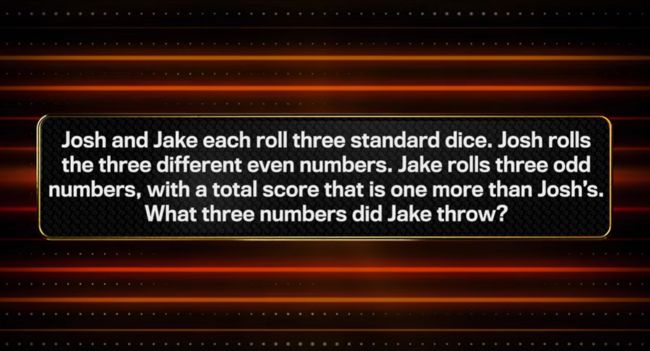
“Josh and Jake each roll three standard dice. Josh rolls the three different even numbers. Jake rolls three odd numbers, with a total score that is one more than Josh’s. What three numbers did Jake throw?”

At first glance, there seems to be plenty to work out.
Which even numbers did Josh roll?
What was his total?
Which three odd numbers could Jake possibly have rolled?
And does “three odd numbers” mean they must all be different?
That final thought can send you down the wrong path.
Because one tiny word appears in the description of Josh’s dice — but is noticeably absent when the question describes Jake’s.
Give yourself 30 seconds before scrolling down to the answer.
Josh’s Score Is Already Fixed

The first part sounds mysterious, but there is actually nothing to guess.
A standard six-sided die contains the numbers:
1, 2, 3, 4, 5 and 6.
There are only three even numbers:
2, 4 and 6.
And we’re specifically told Josh rolls three different even numbers.
Therefore Josh must have rolled:
2 + 4 + 6
His total is:
12
So Jake’s total must be exactly one higher:
13
Now the real puzzle begins.
Jake Needs Three Odd Numbers Totalling 13
The odd numbers available on a standard die are:
1, 3 and 5.
Your first instinct might be to use all three:
1 + 3 + 5 = 9
That’s nowhere near 13.
And this is where some players may think they’ve hit a problem.
If Jake needs three odd numbers, how can he reach 13 using only 1, 3 and 5?
The answer is hidden in the wording.
One Word Changes Everything

Read the two descriptions again.
Josh rolls:
“the three DIFFERENT even numbers.”
But Jake simply rolls:
“three odd numbers.”
The question never says Jake’s numbers have to be different.
That means Jake is allowed to roll the same odd number more than once.
Suddenly, reaching 13 becomes possible.
You need three values selected from:
1, 3 and 5
with repetitions allowed.
And together they must equal:
13.
There aren’t many possibilities.
Final chance before the solution.
The Answer: 3, 5 And 5
Josh’s three different even numbers must be:
2, 4 and 6
So:
2 + 4 + 6 = 12
Jake scores one more than Josh:
12 + 1 = 13
Jake must therefore roll three odd numbers totalling 13.
Those numbers are:
3, 5 and 5
Because:
3 + 5 + 5 = 13
All three results are odd, and the rules never say Jake’s rolls have to be different.
That’s the sneaky part.
The word “different” applies only to Josh.
If you unconsciously apply the same restriction to Jake, the puzzle can appear impossible.
But once you read the wording literally, the entire problem collapses into a few seconds of simple arithmetic — exactly the sort of tiny detail that becomes much easier to overlook when the clock is ticking.