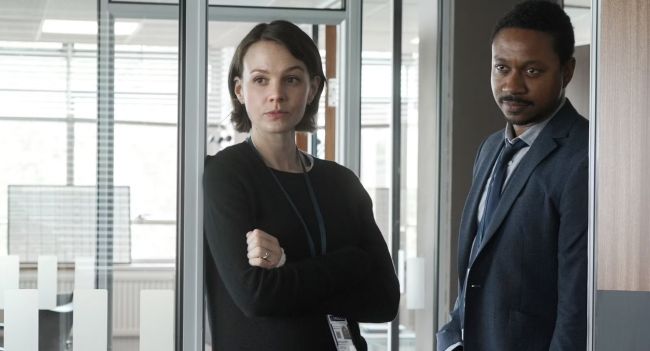
Netflix’s Collateral, released in 2018, is a four-episode crime thriller that can be binged in under 4 hours. The Carey Mulligan-led show perfected the miniseries format with a tight story, sharp character arcs, and sustained tension without deviation.
Collateral proves that short, disciplined crime thrillers pack more impact in an industry that’s drifted away from that efficiency. Although the series flew under the radar, it’s a Netflix hidden gem that deserves attention.
Netflix’s Collateral Is a Twisty Whydunit

Collateral is an unconventional crime drama set in southwest London. It begins with the tragic and seemingly random killing of Abdullah Asif (Sam Otto), a pizza delivery rider shot by a hooded gunman.
As the investigation develops, a pregnant DI Kip Glaspie (Mulligan) partners with DS Nathan Bilk (Nathaniel Martello-White) and DC Rakhee Shah (Vineeta Rishi) to uncover the circumstances behind the murder. Collateral is one of the rare whydunits that reveal the assassin’s identity in the first episode.
The series then uses its remaining three episodes to delve into the traumas and manipulations that drove them to commit the act. Why-dunits can occasionally fall flat with momentum, spending too much time explaining motives or backstories at the expense of forward-moving suspense.
In this case, each new clue challenges viewers’ perceptions of innocence and culpability, making it just as gripping and twisty as a traditional whodunit. Series creator David Hare made every attempt to avoid genre cliches, giving Glaspie an unconventional approach and determination that push her to uncover uncomfortable truths.
Throwing in the complexities of politics, Collateral is less a police procedural and more a character-driven exploration of cause and consequence. The series reaches its climax as multiple storylines combine, driven by strong writing and performances that deliver a satisfying resolution in just four episodes.
Collateral Packs a Lot Into Four Sharp Episodes
The appeal of limited series is that they tell a story within a short timeframe. TV, in general, has become more popular over the past five years, with streaming sites offering options across every genre, from franchise expansions to multi-season shows.
However, there is always an appetite for shorter, condensed stories, particularly among those who prefer films to long-running series. The problem is that, due to ratings and success stories, limited series are becoming sparse, or, at the very least, becoming longer. Financially, this makes sense.
A network or streamer wants to extend a popular story for as long as possible, whether that’s adding more seasons — as was the case with shows like 13 Reasons Why — or hitting that 10-episode mark to drag viewership. Another culprit is the rapidly changing movie industry. With studios mostly pumping out big-budget franchises, the mid-tier prestige drama, once in theaters, is now moving to television.
And since TV movies are now rare, outside of HBO, the only option is to expand it into a full limited series, which means doubling or tripling the runtime. But the viewers are the ones paying for it. Recently, fans have taken to Reddit and social media to express their thoughts on the lengths of newer limited series.
Many believe that shows like Inventing Anna could have been a two-hour movie or a three- to four-episode series at most. Others, even fans of these shows, consider the likes of Big Little Lies and The Sinner to have outrun their course. Overstretched limited series have become the new norm, especially with true-crime docudramas.
The extended runtime theoretically gives these shows room to flesh out supporting characters and the storytelling. But too often, it ends up having a dulling effect, with series repeating the same stories and taking unnecessary detours to fill time, wearing viewers down before the finale.
Another issue is that many of these limited series are based on true stories, events, or books. While 13 Reasons Why worked as a one-season show based on Jay Asher’s novel, the subsequent four seasons extended the story unnecessarily and even contradicted certain aspects of the original season.
It was no longer a story about bullying, abuse, and the effects it had on a young teenager, but a melodramatic saga that lost all focus. Collateral, with a runtime of less than four hours, avoids many of these mistakes. It cuts out filler episodes, inconsistent character development, and unnecessary detours, delivering a concise story that gives viewers everything they need within a short timeframe.
This makes it easier to connect with the story and characters, leaving little room for viewer burnout and predictability. This also means that it leaves a bigger impact than most limited series available today. There’s no sense of waiting for the series to hit its stride, as each scene moves the story forward, giving viewers focused time with Glaspie and the investigation.
A tight four-hour story is easier to retain and reflect on, making every twist and theme more memorable and thus more engaging. In an era of episode inflation, Collateral is a competitive advantage. A compact, adult crime story designed for a single sitting, Hare’s series takes all the fluff out of the genre and instead delivers a standout whydunit that leaves little room for impatience.
Considering the sparsity of such series and the negative feedback towards length over discipline, Collateral should be seen as a prime example of what a limited series can and should be.