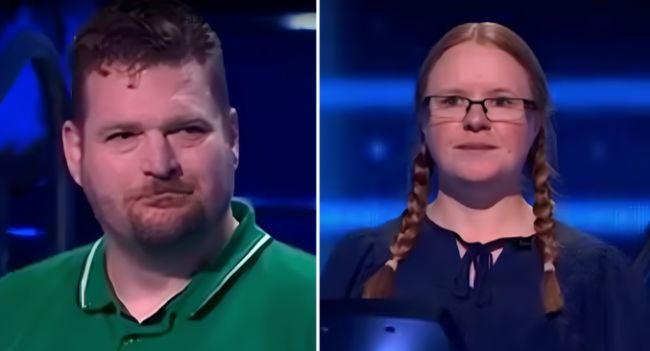
FIVE CONTESTANTS CRACKED THE 1% CLUB’S CONFUSING FINAL QUESTION — THE 30-SECOND PUZZLE THAT HAD VIEWERS STUCK

Six contestants made it all the way to the final round of The 1% Club — but when Lee Mack unveiled the latest 1% question, even viewers at home struggled to work out what was happening.
With just 30 seconds on the clock, the contestants were shown a grid of numbers running from 1 to 49 and given a trail of abbreviated directions.
Lee asked: “Starting on 25, the middle square, SEEN takes you to square 27. From there, NEW takes you to 20. From there, which square does SEWN take you to?”
It sounded like a complicated sequence — but the answer depended on spotting exactly what the letters represented.
THE FINAL 30-SECOND TEST
The six finalists had already built up a combined prize of £94,000, and they could either split their winnings or risk everything by attempting the famously difficult 1% question.
The first contestant to answer gave 12, immediately admitting she knew she had made a mistake.
Then came the breakthrough.
The next contestant confidently answered 20, and the remaining four contestants followed with the same answer.
All five were correct.
Their success meant they became members of The 1% Club and split the £94,000 prize between them — leaving each contestant with £18,800.

WHY THE ANSWER WAS 20
The trick was hidden inside the four-letter sequence.
The letters represented compass directions: S, E, W and N.
Following SEWN meant moving one square south, then one east, then one west and finally one north.
The east and west movements cancelled each other out, while the south and north movements did the same.
That meant the journey brought contestants straight back to the same position — square 20.
Simple once spotted, but much harder with the clock ticking.

VIEWERS WERE LEFT CONFUSED
The result divided viewers watching at home, with some admitting they had struggled to understand what the question was asking.
One viewer described themselves as “so confused” by the puzzle, while another admitted they had answered 25 but had at least realised the question involved compass points.
Others, however, thought the question was surprisingly straightforward.
One viewer declared: “That must have been the easiest 1% question in series so far.”
The split reaction showed exactly why the ITV quiz can be so frustrating — the challenge is often less about knowing information and more about recognising the pattern before the 30 seconds disappear.
LEE MACK’S LOGIC RULE

Lee Mack has previously explained that this logic-based format is precisely what makes The 1% Club different from traditional quizzes.
“You either know them or you don’t straight away,” he said of conventional general-knowledge questions.
“But what’s good about The 1% Club is the questions are about logic. If you don’t know straight away and your brain is quick enough, you can try to work it out in the 30 seconds you have to answer.”
Lee also pointed out that intelligence and knowledge can be very different things, arguing that someone who is not particularly academic can still have a high IQ.
And despite hosting the show, he admitted he had never managed to answer a 1% question correctly himself — his best result was a 5% question.
For the five contestants who cracked SEWN, though, the pressure paid off. With only half a minute to spot the pattern, they found the one detail that sent them straight back to 20 — and into the £18,800 payout.