Dolly Parton’s “Hello God” Remains a Powerful Prayer 25 Years After 9/11
On September 11, 2001, the world changed in a matter of minutes. For Dolly Parton, the shock and grief of that day became the inspiration for one of the most deeply personal songs of her career.
That song was “Hello God,” a searching prayer about fear, faith, violence, human weakness and the desperate need for hope.
Parton released the song on her 2002 album Halos & Horns, her 39th solo studio album and the third installment in her acclaimed bluegrass trilogy. The album arrived on July 9, 2002, and later earned a Grammy nomination for Best Country Album. “Dagger Through the Heart” and “I’m Gone” also received Grammy nominations for Best Female Country Vocal Performance in 2003 and 2004.

A Song Born From the Shock of September 11
The attacks of September 11, 2001, left nearly 3,000 people dead after hijacked planes struck the World Trade Center in New York City and the Pentagon in Arlington, Virginia, while another plane crashed into a field near Shanksville, Pennsylvania.
The events remain one of the defining tragedies of modern American history. For many people who witnessed the attacks unfold, the images and emotions of that day remain unforgettable.
Parton responded to that atmosphere of uncertainty through songwriting.
According to her own explanation preserved in the Dollymania archive, she received several songs shortly after the attacks, including “Color Me America,” “Raven Dove” and the song that would become “Hello God.” The experience left her thinking about how fragile life could be and how quickly circumstances could change.
Parton described the song as something that seemed to demand to be written. She wrestled with the question of why God would allow terrible things to happen, while also expressing the loneliness she associated with a world in which there was no God to turn to.
At the heart of her response was a simple realization: people are not as strong or self-sufficient as they sometimes believe. In moments of overwhelming fear and tragedy, she felt that people needed help.
Faith, Doubt and the Questions We Ask
Parton had long been open about her Christian faith, and “Hello God” reflects that faith without pretending that belief eliminates doubt.
The song begins from a place of uncertainty. It asks whether the world has gone too far to repair itself and confronts the hatred, violence and confusion that people can create while claiming to act in God’s name.
That tension gives the song much of its emotional weight.
Rather than presenting faith as an easy answer, Parton allows room for anger, confusion and difficult questions. She asks why people hurt one another, whether everyone is valued equally and whether humanity has lost its way.
The result is less a traditional declaration of faith than a conversation with God during a moment when the world appears almost impossible to understand.
“Hello God” Is an Appeal for Help
The chorus turns those questions into a direct plea.
Parton addresses God almost as though she is trying to reestablish a line of communication, asking whether He is still listening and whether humanity can receive help as it has in the past.
She also reflects on free will and the ways people have misused it. The song’s central appeal is for love in a world overwhelmed by sadness, violence and despair.
That honesty is part of what has allowed “Hello God” to remain relevant.
The song was inspired by one specific tragedy, but its subject is much broader. Fear, grief, violence, uncertainty and the struggle to understand suffering are not limited to one historical moment. They are experiences people continue to encounter in their own lives.
For Parton, the answer was not to pretend those questions did not exist. She confronted them directly and turned them into a prayer.
A Defining Performance at the CMA Awards
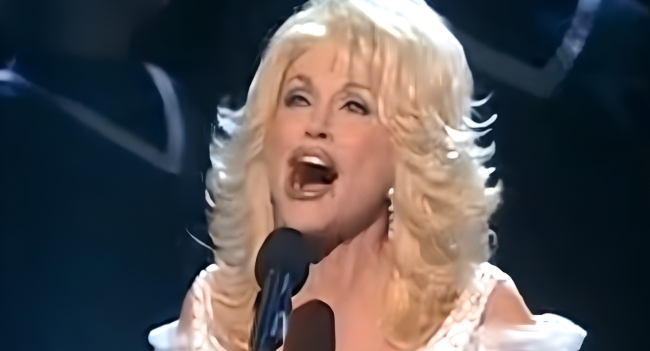
Parton brought “Hello God” to the stage at the 36th Annual Country Music Association Awards in Nashville on November 6, 2002.
Backed by The Christ Church Choir of Nashville, she delivered the song with the kind of conviction that made the performance feel larger than a standard awards-show appearance. The CMA performance also became the song’s music video.
The song was subsequently released as the third single from Halos & Horns on November 11, 2002. It reached No. 60 on Billboard’s Hot Country Songs chart and later won Single of the Year at the International Country Gospel Music Association Awards in 2003.
The Song Became Part of Dolly’s Live Shows
“Hello God” did not disappear after its initial release.
Parton later made it the closing song for every performance on her 2016 Pure & Simple tour, giving the composition a place in her live repertoire more than a decade after it was written.
That choice says something about the importance the song held for her.
Parton was known around the world for her warmth, humor, business instincts and philanthropy, but “Hello God” offers a reminder of the songwriter behind that public image. Her music could be playful and uplifting, but it could also confront grief, doubt and the hardest questions of faith.
In this case, she found a way to put the uncertainty of an entire country into a deeply personal prayer.
Why “Hello God” Still Resonates
Parton’s writing in “Hello God” does not depend on the listener having experienced September 11 firsthand.
Its starting point is the realization that circumstances can change without warning. The song asks what people do when the world they thought they understood suddenly becomes frightening and unfamiliar.
That idea has given it a life beyond the event that inspired it.
The tragedy of September 11 gave Parton the immediate reason to write the song, but the emotions behind it are universal. People face moments when they feel powerless, frightened or unable to make sense of what is happening around them.
“Hello God” gives those feelings a voice.
A Lasting Part of Dolly Parton’s Musical Legacy
Parton’s death on August 25, 2026, at the age of 80 has inevitably brought renewed attention to songs across her remarkable career.
Among the many familiar hits associated with her name, “Hello God” occupies a different kind of space.
It captures Parton at a moment when she was confronting tragedy rather than celebrating success. The song shows her wrestling with questions that did not have easy answers and ultimately turning that uncertainty into an appeal for compassion and divine help.
That may be why the song still feels so immediate a quarter-century after the events that inspired it.
Parton once described the realization behind the song in strikingly simple terms: life is fragile, and everything can change in an instant.
“Hello God” is what she wrote after coming face-to-face with that reality.
And while the song was born from the grief of September 11, its message reaches beyond that day. It is a prayer for people who are frightened, confused or searching for hope when the world seems broken.
That is what makes the song such an enduring part of Dolly Parton’s legacy.
“Hello God”
The studio recording of “Hello God” remains the clearest expression of the song’s original message: a direct, vulnerable appeal to God from someone trying to make sense of suffering, violence and human weakness.
Written and produced by Dolly Parton, the track appeared as the fourth song on Halos & Horns.
More than 25 years after the tragedy that inspired it, the song still stands as one of Parton’s most searching musical statements: a prayer written at a moment of profound uncertainty, and one that continues to speak to anyone who has ever needed an answer in the middle of despair.
It was the perfect tribute that stands the test of time and her voice is just angelic:
The studio cut:
“Hello God”