25 Years Later, Alan Jackson’s “Where Were You” Still Captures What We Felt on 9/11
By Wes Langeler · Country Music · September 11, 2026
Twenty-five years after September 11, 2001, Alan Jackson’s “Where Were You (When the World Stopped Turning)” still carries the strange power of taking people back to that day.
For anyone old enough to remember it, September 11 is more than a date on the calendar. Most people can still picture where they were, what they were doing, who told them, and what they saw when the television came on.
I was in gym class when the first plane struck the World Trade Center. By the time I walked into seventh-grade history, a friend named Tommy Kielbasa had already heard the news and told me that a plane had crashed into the World Trade Center.
I knew about geography and famous landmarks, but I was young enough that I wasn’t even sure what the World Trade Center looked like. I remember being almost embarrassed that I didn’t recognize the name. And because I had no real understanding of terrorism at that age, my first assumption was that some terrible accident had occurred.
Then our history teacher, Ms. Koenig, turned on the television.
We watched the smoke pouring from the buildings. Then came the images of the towers collapsing, followed by clouds of dust and debris moving through the streets of New York.
None of us in that classroom, with the possible exception of our teacher, fully understood what we were watching.
As the day unfolded and the details became clearer, that changed. The attacks in New York and Washington, D.C., the crash in Pennsylvania, the people running through the streets, and the faces filled with fear, confusion, anger and grief made one thing unmistakable: life had changed.
That night, like millions of other Americans, I stayed glued to the news.
And I have never forgotten it.


A Song Born in the Middle of the Night
Less than two months later, the country music community gathered for the 35th annual CMA Awards in Nashville.
The ceremony took place on November 7, 2001, at a time when the country was still grieving and trying to understand what had happened on September 11. The usual celebration surrounding a major awards show was inevitably colored by the events of the previous two months.
Alan Jackson was feeling that weight, too.
He had originally been scheduled to perform his current hit, “Where I Come From.” But on October 28, he woke in the middle of the night with the beginnings of another song in his head.
Rather than risk forgetting the idea, Jackson reached for a handheld recorder and sang the chorus into it while still in bed. He later recalled that he was still in his underwear when he made the recording.
The idea that came to him began with an unusually modest admission from a country singer:
“I’m just a singer of simple songs
I’m not a real political man…”
The song would eventually become “Where Were You (When the World Stopped Turning).”
Jackson stayed home the following day and finished writing it. But at first, he had no intention of recording the song.
That hesitation was understandable. He didn’t want to turn an extraordinary national tragedy into a career opportunity, and he didn’t want the song to become a political statement or a revenge anthem.
What he wanted was much simpler: to describe what he had felt when he watched the second plane hit and to give words to emotions he knew millions of other people were experiencing.
“I didn’t want to write a patriotic song,” Jackson later explained. “And I didn’t want it to be vengeful, either.”
He also worried about whether releasing such a personal song so soon after the attacks would make it appear as though he were exploiting the tragedy.
When he eventually played it for his record label, however, the reaction was unmistakable.
RCA chairman Joe Galante remembered sitting with the others after hearing the song. Nobody spoke for a full minute.
The label wanted Jackson to record it.
Jackson ultimately agreed, even though the attention that followed made him uncomfortable. He felt the song belonged to something much larger than his own career.
He later described that feeling through a line attributed to Hank Williams: “God writes the songs, I just hold the pen.”


The CMA Performance That Stopped the Room
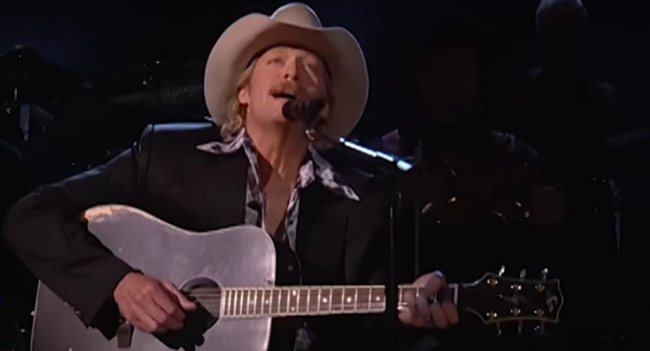
On November 7, Jackson walked onto the CMA Awards stage and sat down in front of an orchestra.
Instead of performing the song everyone expected, he introduced the country audience to a song he had written only days earlier.
“Where Were You” moved through a series of questions about the ordinary people who suddenly found themselves living through an extraordinary day.
Where were you?
Were you teaching children? Driving somewhere? Watching television? Calling your family? Sitting alone in a crowded room?
The song didn’t attempt to explain the attacks or offer a political argument. It focused on the human response to them.
That approach was part of its power.
Jackson was speaking as a songwriter and as someone who had been watching the same television images as everyone else. He wasn’t presenting himself as a historian, politician or commentator. He was trying to understand what had happened alongside everyone else.
The performance lasted roughly five minutes.
When Jackson finished, the audience immediately rose for a standing ovation. The Country Music Association’s own archival record places his performance at 7:36 into its recording of the 2001 ceremony.
The response did not end when the broadcast was over.
The following day, radio stations began taking the live CMA performance from the television broadcast and putting it on the air. Demand grew so quickly that the song began appearing on the country charts even before its official release.
Jackson’s label responded quickly. The studio recording was released on November 26, 2001, and “Where Were You” was added to his upcoming album Drive. The album’s release was also moved forward from May 2002 to January so listeners would not have to wait as long for the song.


The Song Became Bigger Than Jackson Expected
The speed of the song’s success surprised even the man who had written it.
Jackson had never set out to create a massive hit. In fact, he initially assumed the song would eventually fade from public memory as the country moved forward.
Instead, “Where Were You” became one of the defining musical responses to September 11.
It went on to win Song of the Year and Single of the Year at both the CMA Awards and the ACM Awards in 2002. Jackson also won a Grammy for Best Country Song.
The recognition was significant, but the awards were never really the point.
The song had arrived when people were still trying to process grief, fear and uncertainty. Its questions gave listeners room to remember their own experiences rather than telling them how they were supposed to feel.
That helped make it something more lasting than a song tied to a particular news cycle.
Jackson’s lyrics were eventually read into the Congressional Record, and he was invited to perform the song at major 9/11 commemorations. He sang it in New York City on the six-month anniversary, at the Pentagon on the first anniversary, and at the Kennedy Center during an official Washington, D.C., event marking the 10th anniversary in 2011.
The song continued to return each September.
Jackson himself began to notice something he hadn’t anticipated. At concerts, people would wait for it.
Years earlier, he had assumed audiences might eventually stop wanting to hear a song so closely associated with such a painful event. Instead, the opposite happened.
People still wanted to remember.
Alan Jackson Never Saw Himself as the Voice of a Nation
For Jackson, the success came with complicated emotions.
Looking back on the original CMA performance, he has described it as difficult and deeply emotional. More than anything, though, he remembers feeling relieved that he had made it through the performance and proud that the song had connected with people.
He also remained uncomfortable with the amount of attention the song placed on him.
Jackson has always been reluctant to put himself at the center of the story. The success of “Where Were You” created a different kind of spotlight, one that made him feel as though people were placing him on a pedestal.
His own description was much more modest: he was a songwriter and singer who had written a simple country song.
That distinction matters.
Jackson wasn’t claiming to have the answers to what happened on September 11. He wasn’t trying to deliver a political speech. He was documenting an emotional moment and asking listeners to think about their own memories.
That is part of why the song has endured.


25 Years Later, the Meaning Has Changed
Jackson has said that when he first performed “Where Were You,” he expected its relevance to disappear after a few years.
He imagined that eventually he would stop performing it.
That never happened.
Instead, the song evolved. Its meaning became broader than September 11 itself.
At its heart are the themes Jackson came back to repeatedly: faith, hope and love.
That is why “Where Were You” continues to resonate even with listeners who weren’t old enough to remember September 11 firsthand. The song is rooted in one terrible day, but its questions are about how ordinary people respond when their understanding of the world suddenly changes.
A quarter-century later, that emotional core remains intact.


A Song That Still Brings People Back
The story of “Where Were You” has now come full circle.
On June 27, 2026, Jackson performed the song again at his career-capping Last Call: One More for the Road concert at Nashville’s Nissan Stadium. The audience held up phones across the stadium as he sang the song once again, 25 years after its first CMA Awards performance. A new live recording from that concert is being released as part of the 25th-anniversary remembrance.
That image says something about the song’s unusual place in country music.
In 2001, Jackson was simply trying to make sense of what he had seen on television and what he knew so many other people were feeling. He didn’t set out to write an anthem, and he didn’t expect the song to become one.
Yet the song found its way into the memories of millions.
The original CMA performance remains one of the most powerful moments in the awards show’s history, not because it was flashy or theatrical, but because it was restrained. Jackson sat down, picked up his guitar and sang about the questions that had been occupying the minds of an entire country.
Where were you?
What did you do?
Who did you call?
What did you believe?
And how did you feel when the world you knew suddenly seemed different?
Twenty-five years later, those questions still take us back.
For Alan Jackson, “Where Were You” was never supposed to be a monument to himself. It was a way of putting words to a moment when words were difficult to find.
He once thought the song might disappear after a few years.
Instead, every September, people find their way back to it.
And when they do, they remember exactly where they were.