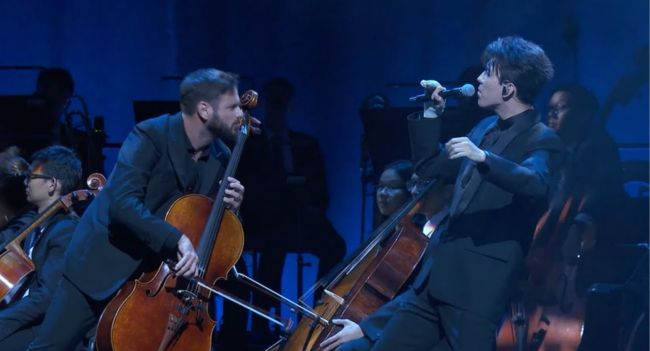
The collaboration between Dimash Qudaibergen and HAUSER on “S.O.S d’un terrien en détresse” unfolds like an emotional storm—quiet at first, almost fragile, before rising into something overwhelming, raw, and unforgettable. This is not just a performance; it feels like a cry from the depths of the human soul, carried by a voice that seems almost otherworldly and a cello that speaks as if it understands every unspoken word.

Originally composed for the French rock opera Starmania, the song has always been known for its emotional intensity and vocal difficulty. It demands not only an extraordinary range but also the ability to convey deep existential longing—the feeling of being lost, disconnected, and desperate to be understood. In this rendition, those themes are amplified to an extraordinary degree.
From the opening moments, HAUSER’s cello sets the tone. The sound is rich, haunting, and deeply expressive, almost like a voice in its own right. Each note feels deliberate, weighted with emotion, creating a foundation that is both delicate and powerful. It doesn’t simply accompany the song—it becomes part of the narrative, echoing the pain and isolation embedded in the lyrics.
Then Dimash enters, and everything changes.
His voice arrives softly, almost like a whisper carried on air, drawing the listener in with a sense of intimacy. There is a vulnerability in those first lines, a quiet confession that feels intensely personal. But as the song progresses, his voice begins to expand—rising, stretching, reaching beyond what seems humanly possible. Dimash is known for his extraordinary vocal range, and here he uses it not as a display of technique, but as a tool for storytelling.

The transition from his lower register to the soaring high notes is seamless, yet emotionally jarring in the best way. It mirrors the inner turmoil of the song—the escalation from quiet despair to an almost desperate outcry. When he reaches those piercing high notes, it doesn’t feel like a performance anymore; it feels like a release, as if the emotion can no longer be contained.
What makes this collaboration particularly powerful is the dialogue between voice and instrument. HAUSER’s cello doesn’t stay in the background—it responds, it reacts, it intensifies the emotion. At times, it feels like the cello is grounding the voice, holding it steady as it threatens to soar into chaos. At other moments, it seems to push the voice further, urging it toward greater intensity.
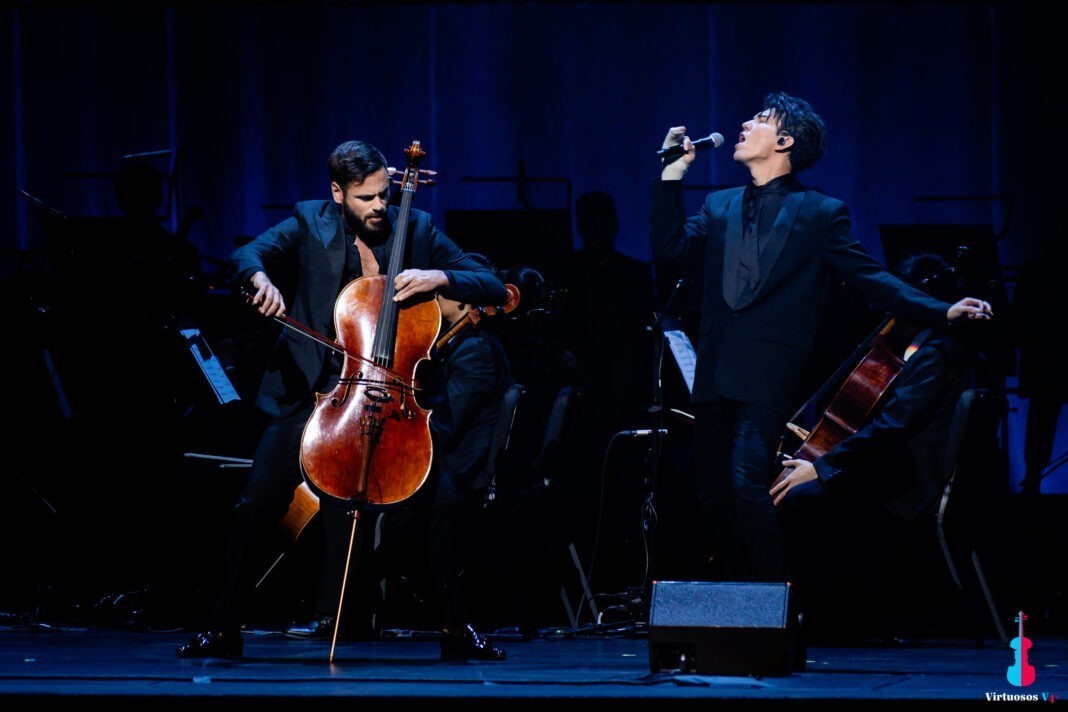
Visually and emotionally, the performance carries a cinematic quality. There is a sense of isolation, of standing alone in a vast space, searching for connection. Even without understanding every word, the emotion transcends language. The pain, the longing, the desperate hope—it is all there, unmistakable and deeply affecting.
As the performance reaches its climax, everything converges. The voice, the cello, the emotion—they rise together into a peak that feels almost unbearable in its intensity. And then, just as suddenly, it begins to fade, leaving behind a silence that feels heavy, almost sacred.
In the end, this rendition of “S.O.S d’un terrien en détresse” is more than a showcase of talent. It is an emotional experience, a journey through vulnerability and strength, isolation and expression. Dimash Qudaibergen and HAUSER do not simply perform the song—they inhabit it, transforming it into something that lingers long after the final note has disappeared.