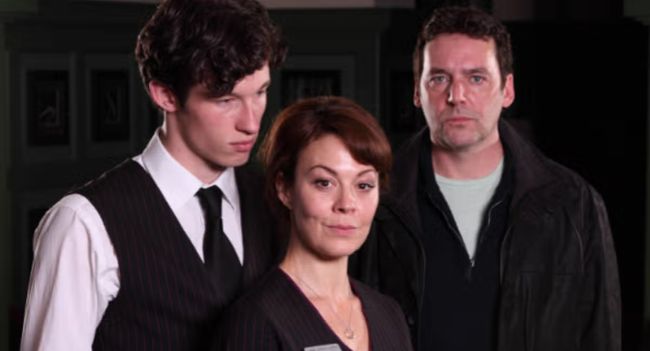
Leaving: Helen McCrory’s Overlooked Three-Part Romance Finds a New Audience on Netflix
More than a decade after its ITV debut, Leaving is finding a second life on Netflix. The three-part British drama, led by the late Helen McCrory and a young Callum Turner, has climbed into Netflix’s Top 10 in several markets, giving viewers a chance to rediscover a quietly powerful story about desire, marriage and the consequences of choosing a life outside the one you already have.
Originally broadcast on ITV in 2012, the miniseries centres on Julie Ranmore, a married mother whose increasingly unhappy home life leaves her emotionally adrift. Her world changes when she meets Aaron, a much younger man who begins working at the same hotel.
Across just three episodes, Leaving builds its story around the attraction between two people whose circumstances make a relationship anything but simple.

A Romance That Comes With Consequences
McCrory plays Julie, a woman in her 40s who is married to Michael, played by Sean Gallagher, and has two children.
Her marriage has become stale, and Julie increasingly immerses herself in her work at a country hotel, where she helps organise wedding receptions — a job that constantly puts her in contact with the romance missing from her own life.
Aaron, played by Callum Turner, enters the story in a very different position. He is young, unemployed and struggling with his own personal disappointments when he first crosses paths with Julie.
Their connection develops after Aaron takes a job at the hotel. What begins as an unexpected attraction eventually becomes an affair, forcing Julie to confront the conflict between what she wants and the responsibilities she has spent years building her life around.
The series does not treat their relationship as a simple forbidden-love fantasy. Julie has a husband, children and an established family life, while Aaron must consider what the relationship means for his own future.
That tension becomes increasingly difficult to escape as their affair continues.

Helen McCrory at the Centre
Much of Leaving rests on McCrory’s performance.
Julie could easily have become a familiar television stereotype — the dissatisfied married woman who falls for someone younger. Instead, the drama spends time examining the emotional contradictions behind her choices and the price attached to them.
Contemporary reviews praised the combination of Tony Marchant’s writing and the cast, with one review describing the series as touching and thought-provoking despite the potentially difficult premise.
Viewers discovering the drama today have also highlighted the performances of both McCrory and Turner, adding another layer of poignancy to the experience of watching it more than a decade after its original broadcast.
McCrory died in April 2021 at the age of 52 after being diagnosed with breast cancer. Her performance in Leaving now carries an unavoidable sense of retrospection, particularly for audiences who first came to know her through some of her later roles.
Before Peaky Blinders Made Her a Global Star

For fans who know McCrory primarily as Polly Gray in Peaky Blinders, Leaving offers an opportunity to see the actress in an earlier stage of her television career.
She would later become closely associated with the BBC crime drama before appearing in projects including Fearless and MotherFatherSon.
Turner was also still at an early point in his career when he made Leaving. He would later take on prominent roles in The Capture and Masters of the Air.
That makes the pairing particularly interesting in hindsight. The series brings together McCrory at a stage before some of her best-known television work and Turner long before he became a familiar face in major productions.
Why the Three-Episode Format Works

Each episode runs for roughly 45 minutes, giving the complete miniseries a total running time of around three hours.
That compact structure makes Leaving an easy binge, but its brevity does not mean the relationship is treated superficially.
The drama has enough room to explore Julie and Aaron’s attraction while also showing the people around them and the consequences their choices create.
The original ITV run consisted of three episodes, broadcast between September 10 and September 24, 2012. Tony Marchant wrote all three episodes, while Gaby Dellal directed them.
A More Complicated Love Story
One of the most effective aspects of Leaving is that it refuses to make Julie’s decision straightforward.
Aaron is determined to pursue the relationship, while Julie remains caught between her feelings and her responsibilities to Michael and her children.
The age difference is an obvious part of the story, but it is not the only source of conflict. The drama is ultimately interested in what happens when a person who has spent years accepting an established life suddenly begins questioning whether that life is enough.
That emotional uncertainty gives the series its weight.
Rather than relying on elaborate twists, Leaving builds tension from increasingly difficult personal choices — and from the knowledge that whatever Julie and Aaron decide, someone else is likely to be hurt.
A Quiet Second Life on Netflix
The series is now available on Netflix, where its arrival has introduced Leaving to a new generation of viewers. Netflix describes it as an intimate British romantic drama about a woman who risks her marriage and family after being drawn into an affair with a younger man.
Its recent appearance in Netflix’s Top 10 TV rankings in the UK, Ireland and Malta shows just how much interest the 2012 miniseries has generated more than a decade after its original broadcast.
For viewers looking for a self-contained British romance rather than a sprawling series, Leaving offers three tightly structured episodes, two compelling central performances and a relationship that becomes increasingly painful as its consequences unfold.
And for anyone familiar with Helen McCrory or Callum Turner’s later work, it also offers something extra: a chance to revisit both actors at very different points in their careers.