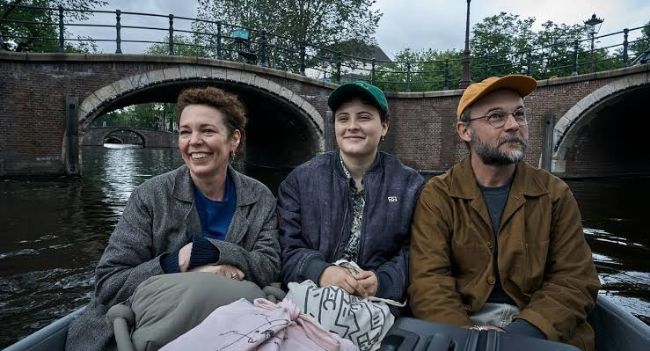
Olivia Colman And John Lithgow Lead A Tender Family Drama About Three Generations Learning To See Each Other Differently
What happens when a teenager looks up to a grandparent as a hero, only to discover that the person behind the legend is far more complicated?
That question sits at the centre of Jimpa, Sophie Hyde’s semi-autobiographical family drama starring Olivia Colman, John Lithgow and Aud Mason-Hyde. The film follows three generations of one queer family as they navigate identity, independence, old resentments and the difficult process of learning how to understand one another.
Rather than building its story around a dramatic family breakdown, Hyde takes a quieter route. Jimpa is interested in the tensions that can exist even inside loving families — particularly when different generations have very different ideas about freedom, responsibility and what it means to live openly.
A Family Trip To Amsterdam Changes Everything
Colman plays Hannah, an Australian filmmaker who travels to Amsterdam with her husband and teenage child, Frances, played by Aud Mason-Hyde.
Their destination is Hannah’s estranged father, Jim, affectionately known as “Jimpa” — a gay activist who has built a very different life for himself in Amsterdam. Frances is immediately drawn to their grandfather’s independent, unconventional world.
The family visit takes an unexpected turn when Frances announces that they want to remain in the Netherlands for a year to finish their schooling.
For Hannah, the decision is about much more than where her child should live.
It forces her to reconsider the version of her childhood and her father that she has carried with her for years. As Frances becomes increasingly fascinated by Jimpa, Hannah has to confront memories and assumptions she may have never fully questioned.
The film therefore turns what initially looks like a straightforward family visit into a generational clash over independence, parenting and the stories families create about their own past.
Jimpa Is Not Quite The Hero Frances Imagined
John Lithgow gives the titular character a flamboyant but vulnerable presence.
Jimpa is charismatic, politically engaged and fiercely independent, having embraced a radically different life after coming out as gay and leaving Australia. But the film does not treat him as an uncomplicated role model.
For Frances, the reality is more complicated than the idealised grandfather they have imagined from afar.
That tension becomes one of the film’s most interesting ideas: people can be pioneers, inspirations and sources of pride while still having flaws that make them difficult to live with.
Jimpa’s generation fought to live openly as gay men at a time when that freedom could not be taken for granted. Frances belongs to a younger generation with its own understanding of identity and language. Hannah is caught between them, trying to make sense of both perspectives while dealing with her own complicated relationship with her father.
Olivia Colman Brings The Emotional Centre
Colman gives Hannah a grounded combination of warmth, humour and uncertainty.
She is not simply the parent standing between a teenager and an unconventional grandfather. Hannah is also a daughter trying to understand the choices her father made and the effect those choices had on her family.
That makes the character’s conflict more personal than a conventional parent-child disagreement.
Several reviews have highlighted the chemistry between Colman and Lithgow, while also praising Aud Mason-Hyde for holding their own alongside two highly experienced performers.
Aud Mason-Hyde’s involvement gives the film another layer of intimacy. They are Sophie Hyde’s own child, and Frances is partly inspired by their experience, although the character is not presented as a direct version of them.
The result is a family dynamic that feels unusually personal without turning Frances into merely a symbol of a younger generation.
Sophie Hyde Draws From Her Own Family
The autobiographical connection is central to Jimpa.
Hyde’s father, Jim, came out as gay when she was young and eventually left Adelaide, while her own child Aud was growing up as a young queer person. Hyde has spoken about wishing her father and child could have met and talked about their experiences.
That personal history became the foundation for the film.
Rather than simply recreating her family’s story, Hyde fictionalises those experiences through Hannah, Jimpa and Frances. The film becomes an exploration of what might happen when three generations with very different experiences of queerness and identity are brought into the same space.
That also explains why the movie spends so much time on conversations, disagreements and emotional misunderstandings rather than relying on conventional dramatic twists.
A Queer Family Story Without Easy Answers
One of Jimpa‘s defining qualities is its refusal to make every disagreement catastrophic.
The film is interested in whether people can disagree without immediately turning against each other — and whether family members can remain loving even when their values, experiences and expectations clash.
Hyde uses humour alongside more serious conversations about identity, ageing, sexuality, parenting and family history. The Amsterdam setting also gives the story a lively backdrop as Frances becomes increasingly immersed in Jimpa’s world.
At the same time, the film acknowledges that openness and progress do not eliminate generational differences.
Jimpa may have spent decades fighting for gay visibility, but that does not automatically make him understand the concerns of a younger non-binary person. Likewise, Hannah’s desire to protect Frances does not mean she always understands what her child needs.
That friction gives the family story much of its emotional weight.
A Personal Drama About Imperfect People

Jimpa has received a mixed critical response, with several reviewers praising the performances while finding the film overly sentimental or occasionally unfocused. Rotten Tomatoes currently lists a 51% Tomatometer score.
Yet even some of the more critical responses acknowledge the strength of its central performances and the intimacy of Hyde’s approach.
The film is at its most effective when it allows its characters to remain contradictory. Jimpa can be generous and selfish, inspiring and frustrating. Hannah can be loving while struggling to let go of old resentments. Frances can admire their grandfather while gradually discovering that the person they idolised is not quite the person they imagined.
That complexity is ultimately what makes Jimpa more than a conventional family drama.
It is a film about how little we can ever fully know the people closest to us — and how much can change when we finally allow ourselves to hear their version of the story.
Rather than offering a neat resolution, Sophie Hyde leaves room for disagreement, affection, disappointment and forgiveness to exist at the same time.
And that may be the film’s most sincere idea: families do not necessarily become stronger because everyone finally agrees. Sometimes they become stronger because they learn how to understand each other without needing to.