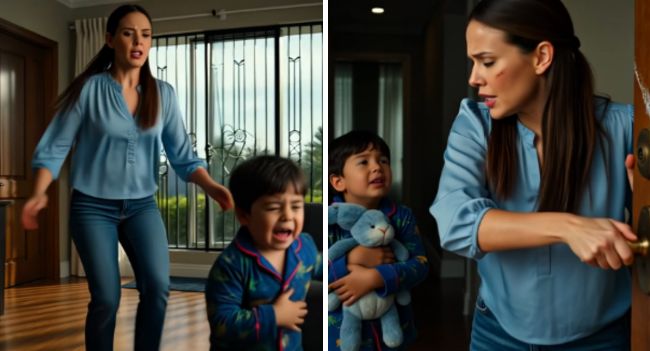
PART 1: THE SOUND OF THE LOCK
The last thing my husband said before he locked us inside sounded casual, almost cheerful.
“You and Leo won’t starve in three days. Be good at home, and I’ll bring you a present when I get back.”
I laughed because I thought it was one of Michael’s strange jokes.
Then I heard the deadbolt slide home twice.
A dry, final sound.
I stood behind the oak door with my hand still raised from waving goodbye. On the other side, Michael’s footsteps moved briskly down the front walk. His suitcase wheels clicked over the cracks in the concrete. A car door opened and slammed.
The engine turned over.
For one second, I nearly unlocked the door and ran outside to remind him to call when he landed.
But the knob would not turn.
I twisted harder.
“Michael?”
The car backed out of the driveway.
I rattled the handle, first with one hand and then with both.
“Michael!”
The engine faded into the pale morning.
Silence settled over the house.
Somewhere down the street, a sprinkler ticked rhythmically across a lawn. A dog barked twice. Our refrigerator hummed behind me.
Everything sounded normal.
Nothing was normal.
“Mommy?”
I turned.
Leo stood in the hallway wearing dinosaur pajamas, his dark hair flattened on one side from sleep. He clutched the faded blue rabbit he had carried everywhere since he was a baby.
“Where’s Daddy going?”
“To work,” I said automatically.
I tried the lock again.
The deadbolt had been secured from outside using the secondary lock Michael had installed six months earlier. He had called it an additional safety feature. I remembered standing beside him while he tested it, smiling when he said no one would ever get into our house without his permission.
At the time, I had thought he meant burglars.
I hurried to the back door.
A thick padlock hung through the exterior latch. I could see it through the narrow glass panel, bright and new against the dark metal.
The garage door would not open. The wall control was dead, and when I pulled the emergency release cord, it stopped after two inches. Michael had threaded a small lock through the mechanism.
Every ground-floor window had iron security bars.
They had always been there, built into the brick when the house was constructed. I had never thought much about them beyond a vague sense of comfort.
Now they looked like the ribs of a cage.
I ran upstairs.
The bedroom windows were sealed behind the same black bars. The guest room window had been painted shut. Even the small bathroom window was too narrow for my shoulders, and when I pushed against it, I discovered screws driven into the frame.
My heart began to pound so violently that my vision pulsed with it.
I grabbed my phone and called Michael.
A recorded voice answered.
“The number you are trying to reach is unavailable.”
I called again.
The same voice.
I opened WhatsApp.
You have been blocked by this contact.
My fingers went numb.
I tried my mother’s old number before remembering she had been dead for four years. I tried Michael’s mother, Carol. The call dropped before it connected.
The signal indicator disappeared completely.
I restarted the phone.
SOS Only.
Our neighborhood had always had poor reception inside the house. We relied on Wi-Fi calling, but the setting was grayed out. When I connected to the home network, basic pages loaded while email, messaging sites, and social media were blocked by the router’s parental controls.
Michael managed the router.
Michael managed the phone account.
Michael managed almost everything.
I tried dialing emergency services.
The call attempted to connect, crackled once, and died.
I ran to the kitchen for the cordless landline before remembering that Michael had canceled it two months earlier.
“Nobody uses those anymore,” he had said.
I had agreed.
I opened the refrigerator.
Two bottles of water.
A half-empty carton of milk.
Nothing else.
No eggs. No cheese. No leftovers from the chicken I had cooked the night before.
The vegetable drawer had been emptied.
I stared into it, my mind refusing to understand what my eyes were seeing.
Then I opened the pantry.
The shelves were bare.
The pasta was gone. The cereal was gone. The cans of soup and beans were gone. The jar of peanut butter was gone.
Even the flour had been removed.
I pulled open the white ceramic rice dispenser Michael had given me for our fifth anniversary. He had presented it with a kiss and a little speech about how I would never have to worry about our family running out of food.
It was spotless.
Not merely empty.
Scrubbed clean.
He had not forgotten to buy groceries.
He had removed them.
The thought moved through me slowly, like ice forming over deep water.
Michael had planned this.
He had calculated what would remain.
He had left enough for us not to die immediately.
Just enough for the suffering to be slow.
“Mommy, I’m hungry.”
Leo had followed me into the kitchen.
I shut the pantry before he could see my face.
“I know, sweetheart. Let’s find you something.”
I searched every cabinet.
Behind a stack of plastic containers, I found half a package of stale crackers. In the fruit bowl, beneath two decorative lemons, there was one wrinkled apple.
That was all.
I gave Leo two crackers and peeled the apple. I cut it into four pieces and placed two in front of him.
“Are you eating?” he asked.
“I already ate.”
It was a lie, but he was three, and he believed me.
I poured him a small glass of milk.
“Drink slowly.”
He nodded solemnly.
Watching him nibble the stale cracker with complete trust was the moment I stopped crying.
Fear remained, cold and heavy inside me, but something harder formed around it.
Michael had expected me to panic.
He had expected me to beg.
He had expected me to wait helplessly for him to come home.
Instead, I began to inventory the house.
One and a half bottles of water after Leo drank.
Less than half a carton of milk.
Sixteen crackers.
Half an apple.
A few ice cubes.
One nearly empty bottle of children’s fever reducer in the upstairs bathroom.
No working telephone.
No food.
No accessible tools.
Michael had even removed the hammer from the kitchen drawer.
I stood in the center of the room, listening to Leo hum to himself as he lined his crackers along the edge of the plate.
Three days.
Why three days?
Why had he chosen that amount of time?
I pictured him sitting in an airport lounge, drinking coffee and checking his watch.
I pictured him smiling at a message from someone else.
Valerie.
The name came to me before I could stop it.
Michael’s college girlfriend had reappeared at a reunion a year earlier, beautiful in a deliberate, unsettling way. She had hugged him too long and looked at me as though I were the woman standing between her and something that had always belonged to her.
Michael had drunk too much that night.
When we got home, he muttered Valerie’s name in his sleep.
I had lain beside him in the dark and told myself it was nostalgia. Old memories. Wine.
I had chosen that explanation because the alternative would have required me to change my life.
After that night, Michael began leaving earlier and returning later. Business trips became more frequent and less specific. The easy warmth between us disappeared—the hand at my back, the kiss against my temple, the way he used to pull me into the kitchen while I was cooking.
Twice, I smelled unfamiliar perfume on his shirts.
Once, I entered the kitchen and saw him ending a call. He deleted several messages with a practiced movement of his thumb.
When I asked who he had been speaking to, he looked at me with contempt.
“You’re becoming controlling, Emily.”
I had apologized.
That memory made me grip the counter until my fingers ached.
I had spent a year afraid that questioning him might break our family.
All the while, he had been learning how much I would tolerate to keep it together.
I went from room to room searching for something I could use to escape.
Michael’s office was locked, but the interior door was thin. I kicked beside the handle until the frame cracked. Pain shot through my foot. On the fourth kick, the latch tore free.
The room smelled faintly of his cologne.
His desk drawers had been emptied. The computer tower was gone. The charging cables were gone. Even the metal letter opener that usually rested beside his keyboard had disappeared.
He had prepared for my desperation.
I searched anyway.
In the wastebasket, beneath a pile of shredded paper, I found one torn corner of a printed reservation.
Only three words remained visible.
Biscayne Bay Resort.
Miami.
And beneath them, written in Michael’s handwriting:
V—Friday, 7:30.
I sat down in his chair.
The business trip was real only in the sense that Miami was real.
He had gone there.
Just not for business.
“Mommy?”
Leo stood in the doorway.
His lower lip trembled.
“Why did Daddy lock us in?”
I opened my mouth.
No answer came.
He was only three, but children understand fear before they understand explanations. He had heard me pounding. He had watched me search the cabinets.
He knew something was wrong.
I crossed the room and knelt in front of him.
“Daddy made a very bad choice,” I said. “But I’m going to get us out.”
“Today?”
The word nearly broke me.
“Yes,” I lied. “Today.”
I held him until his breathing slowed.
Then I stood and began trying to dismantle the front door.
The hinge pins were capped and reinforced. The screws had been stripped. I wedged a butter knife into the frame and twisted until the blade snapped.
I used the iron fireplace poker as a lever.
I pulled until my shoulders burned.
The wood groaned but did not give.
By afternoon, both my palms were blistered.
By evening, the skin had split open.
I wrapped my hands in dish towels and kept working.
When darkness settled beyond the barred windows, the house no longer felt like our home.
It felt like something Michael had built for me without my noticing.
Every canceled account.
Every password he had insisted on controlling.
Every tool that had disappeared.
Every relationship that had quietly weakened.
Layer by layer, he had removed the exits.
I put Leo to bed beside me in the master bedroom. I gave him two more crackers and the rest of his apple pieces.
I drank three small mouthfuls of water.
“Daddy will bring my present?” Leo whispered.
I stared into the darkness.
“Yes,” I said, because I did not know what else to tell him.
Sometime after midnight, I heard the pipes groan inside the walls.
A low mechanical click came from beneath the kitchen floor.
I went downstairs and turned the faucet.
Water ran for two seconds.
Then it coughed, spat a thin brown stream, and stopped.
Michael had shut off the water.
And he had done it remotely, almost sixteen hours after leaving us inside.
He was not merely ignoring us.
He was watching the time.
PART 2: THE HOUSE BECOMES A CAGE

I filled every container I could find with the water remaining in the pipes.
A saucepan caught half a cup.
The bathroom faucet produced a few cloudy mouthfuls. I collected them in Leo’s plastic dinosaur cup.
The upstairs toilet tank held clean water, but I knew once it was gone, there would be no more.
By morning, my throat felt coated with dust.
Leo woke before sunrise and asked for pancakes.
I turned my face away so he would not see me cry.
“We’re having a picnic breakfast today.”
I placed two crackers on a towel and gave him a spoonful of milk.
He smiled because he trusted me to make ordinary things fun.
That trust felt heavier than hunger.
I tried the emergency number again from every room in the house. In the upstairs bathroom, the phone connected long enough for me to hear a distant voice.
“Emergency services. What is your—”
The call died.
I climbed onto the counter and held the phone against the narrow window.
Nothing.
I typed a message into the emergency text screen.
LOCKED IN HOUSE WITH CHILD. 18 BRIAR LANE. HUSBAND LOCKED DOORS. NO WATER.
The message remained unsent.
I tried to create a new email account through the browser, but the router redirected me to a blocked-access page. I tried the contact form on a local news website. Blocked. I tried an online store’s customer chat and typed HELP before the connection closed.
Michael had not simply cut off my phone.
He had built a wall around every route outward.
I carried a dining chair upstairs and struck the bedroom window.
The first blow made Leo scream.
The glass cracked but did not shatter. A transparent security film held it together.
I struck it again.
The chair leg snapped.
On the third blow, a hole appeared. Cold air rushed through it, carrying the smell of cut grass.
For one wild second, hope flooded me.
I tore at the fractured glass with a towel wrapped around my hand. Small shards sliced through the fabric. Blood spread across the white cotton.
Behind the glass, the iron bars remained.
They were bolted into the exterior brick.
I screamed through the opening.
“Help! Somebody help us!”
The houses on our street were spaced far apart, separated by high hedges and wide lawns. The nearest neighbors were an elderly couple who spent most weekends at their daughter’s house.
I shouted until my voice broke.
No one came.
I tied one of Michael’s white dress shirts to the bars and wrote HELP across it with red lipstick. The fabric fluttered weakly behind the hedge.
From the street, it would probably look like laundry.
I considered starting a fire to trigger the smoke alarms.
Then I remembered Michael had disconnected the monitored alarm system during renovations and never restored it.
A fire would not summon help.
It would only fill a sealed house with smoke while my son was trapped behind iron bars.
Every escape I imagined led to another trap.
By noon, Leo became quiet.
Too quiet.
He sat on the living room floor with his rabbit in his lap, watching dust move through the sunlight. When I asked if he wanted to play, he shook his head.
I touched his forehead.
Warm.
I told myself it was the heat. The house had begun to feel stale and close without the air conditioner running properly. Michael had adjusted the thermostat remotely, raising it to eighty-two degrees.
I gave Leo a few drops of water.
“More,” he whispered.
“Soon.”
That was the cruelest word I used during those two days.
Soon.
Help would come soon.
Daddy would come soon.
We would drink soon.
We would eat soon.
Every time I said it, I turned uncertainty into a promise.
I searched the house again, this time without caring what I destroyed.
I tore cushions apart.
I emptied coat pockets.
I checked beneath beds, behind appliances, inside decorative boxes.
In the pocket of one of Michael’s old winter jackets, I found a protein bar.
It had expired eight months earlier.
I almost laughed.
I divided it into six pieces.
Leo ate one and asked whether Daddy had left it for us.
“No,” I said.
It was the first time I stopped protecting Michael in front of his son.
“No, sweetheart. Daddy took the food away. I found this.”
Leo stared at me.
“Was I bad?”
The question punched the air out of me.
I pulled him into my arms.
“No. Never. You did nothing wrong.”
“Did you?”
I closed my eyes.
“No.”
That answer mattered.
For the first time in years, I said it without doubt.
I had done nothing to deserve this.
My suspicion had not caused Michael’s betrayal.
My questions had not caused his lies.
My fear had not created his cruelty.
I had spent so long examining my own behavior that I had stopped examining his.
That afternoon, I broke the lock on the cabinet beneath the stairs.
Inside were old paint cans, a roll of electrical wire, and a toolbox.
The toolbox was empty except for a pair of pliers and a small flat-head screwdriver.
I took both.
At the front door, I began removing the decorative trim around the frame. The screwdriver slipped repeatedly because my hands were slick with blood.
I kept going.
Piece by piece, I exposed the wood surrounding the deadbolt.
It was reinforced with a steel plate.
Michael had installed it himself.
I remembered him standing there with a power drill while Leo watched from his high chair.
“Now my family is safe,” he had said.
I had kissed his cheek.
The memory filled me with such violent anger that I drove the screwdriver into the wood until the handle cracked.
I wanted to tear the entire house apart.
I wanted Michael to return and find nothing standing.
But rage used energy I could not afford.
I sat on the floor and forced myself to breathe.
Leo needed me alive.
Leo needed me thinking.
I searched Michael’s office again.
This time I examined the shredded paper in the wastebasket. Most of it was too finely cut to reconstruct, but several pieces had been folded together before being destroyed.
I arranged them on the desk.
They formed part of a printed message.
Can’t keep waiting—
—prove you’re serious—
—Friday through Monday—
The last visible fragment contained a single letter.
V.
Valerie.
My hands began to shake.
This was not a spontaneous act of cruelty before a business trip.
Someone else knew.
Someone else had discussed the dates.
Someone else was waiting for Michael while he locked his wife and child inside a house without food.
I remembered Valerie at the reunion.
Her hand on Michael’s arm.
The small smile she gave me when I introduced myself.
Not surprise.
Recognition.
She had known exactly who I was.
Maybe she had known much more than I did.
Leo began crying upstairs.
I ran to him.
He was curled on the bed, shivering despite the heat.
His face was flushed. His lips looked dry.
I pressed my palm to his forehead.
He was burning.
The thermometer read 102.4.
I found the nearly empty bottle of children’s fever medicine. There was barely enough for one full dose.
I gave it to him with a mouthful of milk.
Then I dampened a washcloth with water from the toilet tank and laid it across his forehead.
“I want Daddy,” he whimpered.
I swallowed the answer that rose inside me.
So did I.
Not the man who had locked us in.
I wanted the Michael who once drove through a snowstorm to bring me soup when I was sick. The Michael who cried the first time he held Leo. The Michael who used to leave notes in my lunch bag and dance badly in the kitchen.
I wanted the man I had married.
But that man had either disappeared or had never existed in the way I believed.
The sheets know what a marriage is like better than the photographs do.
Our photographs showed smiles, birthdays, vacations, Christmas mornings.
They did not show the nights I lay awake listening to Michael text someone beneath the blankets.
They did not show the way he controlled the bank accounts because he was “better with money.”
They did not show how he told me Carol disliked me, then told Carol I was too busy whenever she asked to visit.
They did not show how small my world had become.
By evening, Leo’s fever had risen to 103.
I gave him the last of the milk.
There were eight crackers left, two pieces of protein bar, and less than a bottle of water.
I had eaten nothing since the morning before.
My legs trembled when I stood.
I carried Leo into the upstairs bathroom because it was the coolest room. I lowered us onto the tile and held him against my chest.
Outside, daylight faded.
The second night arrived.
It was the longest night of my life.
Leo drifted in and out of sleep. Sometimes he whispered nonsense. Once he opened his eyes and called me Valerie.
The name coming from his mouth terrified me.
I knew it was the fever.
Still, it felt like a message carried from the life Michael had hidden.
At two in the morning, Leo began coughing.
At three, he vomited what little water he had swallowed.
At four, I stopped believing Michael would return in time.
I carried Leo downstairs and laid him on the couch.
Then I went to the kitchen and pulled the heaviest drawer from the cabinet.
I struck the front door with it.
Once.
Twice.
Again.
The wood split. The drawer broke apart.
I used one jagged piece as a wedge against the exposed frame. I kicked it with my heel until my ankle went numb.
The deadbolt did not move.
I screamed Michael’s name.
I screamed until I was no longer forming words.
When my voice failed, I pressed my forehead against the door and sobbed.
“I’ll sign anything,” I whispered, though no one was there to hear me. “Take the house. Take the money. Just let Leo out.”
The words left my mouth before I understood them.
Then I froze.
I’ll sign anything.
Was that what Michael wanted?
Not to kill us.
Not exactly.
To weaken me.
To frighten me until survival mattered more than whatever he put in front of me.
The thought was so clear that I stepped away from the door.
Three days.
A controlled period of hunger, thirst, heat, and fear.
Then he would return.
He would unlock the door.
He would present the “gift” he had promised.
Papers, perhaps.
A confession.
A demand.
He believed that after three days, I would be grateful enough to accept anything.
The realization steadied me.
Michael had made one mistake.
He had assumed terror would erase my judgment.
Instead, it erased my loyalty to him.
I went upstairs, removed the bright red bedspread from the guest bed, and pushed it through the broken section of the bedroom window. I tied it around the bars and let it hang down the exterior wall.
Then I wrote three words across the fitted sheet with black eyeliner.
CHILD SICK. HELP.
I tied that beneath it.
The red fabric was impossible to ignore.
At sunrise, I began striking the heating pipe with the metal pliers.
Three blows.
Pause.
Three blows.
Pause.
Three blows.
The international distress signal, or close enough.
I continued until my arm would no longer rise.
At some point, I must have lost consciousness.
I woke on the hallway floor with sunlight on my face.
For several seconds, I did not remember where I was.
Then I heard Leo make a weak sound from the living room.
I crawled to him.
His skin was hotter than before.
His eyes barely opened.
I reached for the last bottle of water.
It was empty.
I had forgotten that I had used the final drops to wet his lips.
Something inside me broke.
Not gently.
Not sadly.
It broke with the force of a snapped bone.
I left Leo on the couch and staggered to the front door. I struck it with my shoulder again and again.
“Help us!”
My voice was hardly more than air.
“Please!”
I hit the wood with both fists.
Blood marked the door.
Then, from the other side, I heard someone shout my name.
“Emily?”
I stopped moving.
For a moment, I thought I had imagined it.
“Emily!”
A woman’s voice.
Older. Sharp. Terrified.
Carol.
I pressed my face to the door.
“Carol!”
“Oh, my God.”
Her hands struck the other side.
“Are you in there?”
“Leo’s sick. We need water. The doors are locked from outside.”
A silence followed.
Not confusion.
Recognition.
Then Carol spoke in a voice I had never heard her use.
“Move away from the door.”
“What?”
“Take Leo and move away.”
I heard metal scrape against concrete.
A heavy object being lifted.
“Carol?”
“Get back, Emily.”
The first blow shook the entire frame.
The second cracked the oak.
The third drove the deadbolt plate halfway through the wall.
My mother-in-law stood on the front porch with a sledgehammer in both hands.
And she swung as though she intended to bring the whole house down.
PART 3: THE WOMAN WITH THE SLEDGEHAMMER
The door gave way on the seventh blow.
It did not swing open. It collapsed inward in a shower of splintered wood and plaster.
Carol stepped through the wreckage.
Her gray hair had come loose from its clip. Sweat darkened the collar of her blouse. She still held the sledgehammer, but her hands were shaking so badly that she let it fall the instant she saw me.
For years, I had believed Carol barely tolerated my presence.
She was formal around me. Careful. She rarely called. When she visited, she stayed less than an hour and always seemed eager to leave.
Michael told me she thought I was overly sensitive.
He told me she believed I had taken him away from his family.
He told me she questioned my parenting.
I had built an entire picture of her from information he supplied.
Now she crossed the ruined entryway and caught me before I fell.
“Where is Leo?”
I pointed toward the living room.
She ran.
The moment she saw him, she made a sound I will never forget.
It was the sound of a mother recognizing that her own child had endangered hers.
She touched Leo’s face, then grabbed her phone.
“Three-year-old male, high fever, possible dehydration,” she told the emergency dispatcher. “He and his mother were locked inside their house for almost two days. No food. No water.”
She looked at me as she said the last words.
There was horror in her face.
And beneath it, guilt.
An ambulance arrived within minutes.
The paramedics gave Leo oxygen and started fluids through a tiny needle in his arm. He cried weakly when they lifted him onto the stretcher, and that cry was the most beautiful sound I had ever heard.
It meant he still had strength.
I climbed into the ambulance with him.
Carol followed in her car.
At the hospital, nurses took Leo through a set of double doors while a doctor examined my hands. I had cuts across both palms, bruising along my shoulder, and signs of dehydration.
“Your son is responding to fluids,” a nurse told me. “His fever is coming down.”
I nodded.
Then I vomited into a plastic basin.
My body had waited until Leo was safe before allowing itself to fail.
Carol sat beside my hospital bed.
For a long time, neither of us spoke.
She held her purse tightly against her lap, her fingers locked around the strap.
Finally, I asked the question that had been beating inside my head since she appeared outside the door.
“How did you know?”
Carol looked toward the hallway.
“I didn’t. Not at first.”
“What does that mean?”
“Michael called me yesterday morning.”
My mouth went dry.
“He called you?”
“He said you had taken Leo to stay with a friend. He said the two of you had fought and that you wanted space. He asked me not to contact you.”
I stared at her.
“I don’t have a friend nearby.”
“I know that now.”
“You knew it before.”
Carol flinched.
“Yes.”
“Then why did you believe him?”
“Because I have spent most of Michael’s life believing him.”
Her answer held no defense.
Only shame.
She opened her purse and removed an old tablet with a cracked corner.
“Michael left this at my house months ago. He used it during a visit and forgot it in the guest room. Yesterday afternoon, it began receiving his messages.”
She placed it in my lap.
My hands were bandaged. Carol unlocked the screen for me.
A conversation was open.
Michael’s name appeared at the top.
The messages beneath it were addressed to Valerie.
I read the first visible line.
VALERIE: Are you sure she can’t contact anyone?
MICHAEL: Phone’s handled. Router too. Doors are locked.
My breathing changed.
Carol reached for me, but I pulled away.
I scrolled.
VALERIE: And Leo?
MICHAEL: He has milk. They’ll be fine.
VALERIE: Three days is a long time for a child.
MICHAEL: Don’t start pretending you care now.
The words blurred.
I blinked until they became sharp again.
VALERIE: I care about what happens if this becomes a problem.
MICHAEL: It won’t. Emily panics, then she folds. By Monday she’ll sign whatever I put in front of her.
I stopped.
My earlier realization returned with sickening clarity.
“He was going to make me sign something.”
Carol nodded.
“There are more messages.”
I did not want to read them.
I made myself continue.
VALERIE: You said the house would be yours.
MICHAEL: It will. The deed and settlement are ready. She doesn’t know how much is in the accounts anyway.
VALERIE: What about custody?
MICHAEL: She’ll take Leo. I don’t want the daily responsibility. I just don’t want her getting enough support to interfere with our life.
My vision narrowed.
He had locked his son inside a house without food to reduce the amount of money he might someday have to pay for him.
Leo was not a person in those messages.
He was an expense.
A responsibility.
A bargaining piece.
The nurse had warned me not to stand, but I got out of bed anyway.
The floor moved beneath me.
Carol caught my elbow.
“Emily.”
“I want to see him.”
“Leo is being monitored.”
“I want to see my son.”
My voice rose, and a nurse appeared.
They brought me to Leo’s room in a wheelchair.
He lay beneath a thin blanket with an IV taped to his arm. His color had improved. His eyes opened when I touched his hair.
“Mommy?”
“I’m here.”
“Did Grandma break the house?”
I laughed and cried at the same time.
“Yes.”
“Is Daddy mad?”
The room became very still.
“No,” I said. “Daddy doesn’t get to be mad.”
Leo considered that.
Then he closed his eyes.
Carol stood in the doorway.
For years, I had believed she had judged me.
Now I saw tears moving silently down her face.
Later, while Leo slept, Carol told me everything Michael had hidden between us.
She had called many times during the first year after Leo was born.
Michael told her I did not want visitors.
When she sent birthday gifts, Michael sometimes returned them, claiming I found them inappropriate.
When she invited us for holidays, he said I refused to go.
Meanwhile, he told me Carol was disappointed that I had not returned to work sooner. He told me she thought I spoiled Leo. He told me she found my grief after my mother’s death exhausting.
Every injury between us had passed through Michael first.
“He kept us apart,” I whispered.
Carol nodded.
“He did the same thing with his father.”
I looked at her.
“His father?”
“Michael’s father controlled everything. Money. Transportation. Who I spoke to. Where I went. He never locked me in a house, but he made sure I could not leave it without asking.”
Carol’s eyes remained on Leo.
“I spent years telling myself Michael was different because he hated his father. I didn’t understand that hating what someone does doesn’t always stop you from learning how to do it.”
“Did you know about Valerie?”
“No. I knew her in college. I never liked the way they were together. They made each other feel justified in every selfish impulse.”
She swallowed.
“When the messages appeared, I called Michael. I asked where you were. He told me not to interfere. Then he said something his father used to say to me.”
“What?”
“That a frightened woman is an obedient woman.”
My skin went cold.
“I drove to your house. I saw the sheet hanging from the window. I heard the pipe.”
“The sledgehammer?”
“I stopped at a hardware store.”
Despite everything, a broken laugh escaped me.
Carol covered her face.
“I should have come sooner.”
“You came.”
“I believed him for too long.”
“So did I.”
That was the first honest thing we had ever said to each other.
A police officer arrived that afternoon.
Carol gave him the tablet. I described the locks, the missing food, the disabled communications, and the water shutoff.
The officer photographed my hands.
He photographed Leo’s IV.
He sent another team to secure the house.
“Do you know when your husband is returning?” he asked.
“Monday.”
It was Saturday afternoon.
The officer nodded.
“We’re attempting to locate him.”
I looked at Carol’s tablet.
Michael and Valerie had stopped messaging after Carol called him.
He knew something had changed.
“He won’t come home,” I said.
“Maybe not.”
“He’ll run.”
“We’ve notified the appropriate agencies.”
That answer did not satisfy me.
Michael had spent years controlling what I knew and when I knew it.
I wanted him to hear my voice before someone else reached him.
I wanted him to understand that the woman he had locked inside that house no longer existed.
“Can I call him?” I asked.
The officer studied me.
“From a recorded line, with your consent.”
I nodded.
Carol gave them Michael’s number.
He answered on the third ring.
“Mom?”
His voice sounded irritated.
Not frightened.
Not remorseful.
I leaned toward the phone.
“It’s me.”
Silence.
Then Michael exhaled slowly.
“Emily.”
“You sound disappointed.”
“Where are you?”
“At the hospital.”
Another silence.
“Is Leo okay?”
The question came too late.
“You knew he had only milk.”
“I knew you would manage.”
“He had a fever of one hundred and three.”
“I couldn’t have predicted that.”
“You removed his food.”
“There were crackers.”
My entire body began to shake, but my voice remained steady.
“You locked a three-year-old inside a house without water.”
“The water wasn’t supposed to shut off until Sunday.”
The officer’s eyes lifted sharply.
Michael heard himself too late.
He changed direction.
“I was trying to make a point.”
“What point?”
“That you can’t keep questioning me and turning the house into a war zone.”
“You were in Miami with Valerie.”
“My personal life stopped being your concern when you began spying on me.”
“You left messages on your mother’s tablet.”
A long breath.
“Of course she showed you.”
“She broke down the door.”
Michael laughed once, without humor.
“My mother always did enjoy a dramatic rescue.”
I looked through the glass at Leo.
His small hand rested beside his face, an adhesive bandage covering the IV site.
“What were you bringing me on Monday, Michael?”
He did not answer.
“The settlement?”
“You’re emotional right now.”
“The deed?”
“We can discuss that privately.”
“The papers giving you the house while Leo and I leave with almost nothing?”
“You don’t understand our finances.”
“I understand you thought hunger would make me sign.”
“You were never in danger.”
The words hollowed the room.
I remembered striking the door while Leo burned with fever behind me.
“You heard me ask whether Leo was okay,” I said. “But you never asked whether I was.”
Michael’s voice softened.
It was the voice he used when he wanted other people to see him as reasonable.
“Emily, I know you’re upset. I made a mistake. Come home. We’ll talk through this.”
I almost admired the confidence required to say it.
“You locked us inside that home.”
“And now you’re out.”
“As though nothing happened?”
“I said it was a mistake.”
“No. A mistake is forgetting to buy milk. You emptied the pantry. You disabled my phone. You locked the garage. You reinforced the door. You shut off the water. That was a plan.”
His silence confirmed more than an answer could have.
“I want to speak to Leo,” he said.
“No.”
“I’m his father.”
“You remembered that when it became useful.”
“Put my son on the phone.”
The command in his voice was familiar.
For years, that tone had made me explain myself, apologize, retreat.
This time, it had nowhere to land.
“You will not speak to Leo until the people protecting him decide it is safe.”
“Emily.”
“You said a frightened woman is an obedient woman.”
Michael went silent.
I continued.
“You were right about one thing. I was frightened. I was frightened every time you came home late. Every time you called me controlling. Every time you made me think your mother hated me. Every time I wondered whether asking the truth would destroy our family.”
My voice broke, but I did not stop.
“Then you locked me inside a house with our sick child, and I learned something.”
“What?”
“Fear has an ending.”
The officer gestured that the call should conclude.
I looked at Carol.
She nodded.
“You promised to bring me a present,” I said.
Michael said nothing.
“You did. You gave me three days without your lies.”
I ended the call.
PART 4: WHAT HE THOUGHT THREE DAYS WOULD BUY HIM
Michael was arrested the following morning at the Miami airport.
He and Valerie had booked new flights after learning Carol had reached us. They were attempting to leave before the police obtained the evidence from the house.
Valerie was not arrested. The messages showed that she knew we had been locked in, but Michael had arranged the locks, disabled the phone, removed the food, and controlled the utilities.
She later claimed she believed I had access to supplies he had not mentioned.
I never learned whether that was true.
I stopped needing to know.
Valerie had wanted a life with Michael badly enough to accept the story he gave her. I had done the same thing once.
The difference was that when she learned a child had been placed in danger, she stayed beside him.
That choice belonged to her.
Michael’s choices belonged to him.
Mine were finally mine again.
Leo remained in the hospital for two nights. His fever came from a viral infection made worse by heat and dehydration. The doctor said we had reached him in time.
In time.
Those words haunted me.
A few more hours.
A higher fever.
One less hidden protein bar.
One delayed visit from Carol.
The outcome could have been different.
When we left the hospital, I refused to return to the house.
Carol opened her home to us.
The first night there, she filled the kitchen counters with food.
Bread, soup, fruit, cereal, crackers, juice, milk.
Too much food.
An entire wall of proof that Leo would not have to ask whether he was allowed to eat.
He walked from item to item with wonder.
“Is this all ours?”
Carol knelt beside him.
“As much as you need.”
Leo selected a banana and carried it to me.
“Mommy eats too,” he announced.
I sat at Carol’s kitchen table and cried while eating half of it.
For several weeks, Leo panicked whenever he heard a lock.
He would run to the nearest adult and ask whether the door opened from both sides.
At night, he woke screaming that Daddy had taken the water.
I began sleeping on a mattress beside him.
Carol left every interior door open.
She placed bottled water in every room.
Sometimes I found her standing in the hallway after midnight, listening to make sure we were breathing.
Trauma made rituals of us all.
The legal process moved slowly, but the evidence did not depend on my word alone.
There were store receipts for the new padlocks.
Records showing Michael had deactivated my phone line the night before leaving.
Router logs showing that he blocked communication services.
A remote command from his account shutting off the water.
The messages with Valerie.
The torn reservation.
Photographs of the empty pantry.
My blood on the door.
The hospital records.
Most damaging of all was his recorded admission.
The water wasn’t supposed to shut off until Sunday.
He had said it as though the timing made him less guilty.
It proved he knew exactly what he had done.
Michael’s attorney initially described the confinement as a “marital dispute that escalated.”
The phrase appeared in a document I received.
I read it three times.
A dispute suggested two people arguing.
This had been one person planning and another person surviving.
I wrote my own statement.
I described Leo thanking me for stale crackers.
I described his question: Was I bad?
I described holding a wet cloth against his forehead while the final bottle of water emptied.
I described begging a locked door to save my son.
I did not soften anything to protect the memory of the man I had once loved.
That was another door Michael no longer controlled.
The divorce papers he had intended to force me to sign were found in a folder inside his luggage.
He had planned to return Monday evening.
According to the messages, he intended to unlock the door, offer us water, and place the settlement in front of me while I was weak.
The agreement gave him the house, most of our savings, and control over the timing of support payments.
In exchange, he would allow Leo and me to remain in the guest apartment of one of his company’s properties for six months.
Allow.
That word appeared nine times.
Michael had imagined himself returning as our rescuer.
He would create the emergency and then offer relief.
He believed gratitude would erase the crime.
He believed I would sign because survival had taught me to obey.
Instead, the court froze the accounts and granted me temporary control of the marital home.
I sold it as soon as I was legally able.
I never stepped inside again.
Carol handled the movers.
She packed Leo’s clothes, my mother’s photographs, and the blue ceramic bowl I had made in college.
She threw away the anniversary rice dispenser.
“Are you sure?” she asked me first.
I thought about its clean, empty interior.
“Yes.”
She smashed it in the trash bin.
Not with the sledgehammer.
But I could tell she considered it.
Michael wrote me six letters from jail.
I opened the first.
He said he loved me.
He said Valerie had manipulated him.
He said pressure at work had changed him.
He said his father’s behavior had damaged him more than anyone understood.
He said he never intended for Leo to become sick.
He said he believed three days apart would help me “recognize the value of our marriage.”
Not once did he say:
I chose to lock you in.
I chose to remove the food.
I chose to endanger our son.
Every apology contained a hidden door through which he could escape responsibility.
I stopped opening the letters.
Carol read none of them.
“He is my son,” she said one evening, “but being his mother does not require me to protect him from the consequences of what he became.”
I looked at her across the kitchen table.
“Do you still love him?”
She took a long time to answer.
“Yes.”
Her honesty surprised me.
Then she continued.
“But love is not the same as permission.”
That sentence stayed with me.
For years, I had treated love as permission.
Permission to lie.
Permission to control.
Permission to isolate me.
Permission to make me doubt myself.
I thought refusing permission meant I had failed to love him enough.
Now I understood that love without boundaries could become a hiding place for cruelty.
The criminal case ended with Michael accepting a plea agreement. He was convicted of unlawful imprisonment, child endangerment, and related offenses.
The sentence did not feel long enough.
Perhaps no sentence would have.
There is no number of months that equals the sound of a thirsty child asking for water.
There is no legal phrase that captures what it means to discover that the person beside you has been quietly turning your home into a trap.
But the conviction placed the truth somewhere permanent.
He could no longer call it a misunderstanding.
He could no longer rewrite it as an argument.
He could no longer tell people I had imagined the locks.
The locks existed.
The empty shelves existed.
The hospital records existed.
We existed.
And we survived him.
PART 5: THE DOOR THAT OPENED BOTH WAYS
A year after Carol broke down the front door, Leo and I moved into a small rental house across town.
It was not impressive.
The kitchen counters were chipped. The bedrooms were small. The backyard fence leaned slightly to the left.
But sunlight filled the living room in the afternoon, and every window opened.
Before signing the lease, I checked them myself.
I opened and closed each one.
I tested the front door.
I tested the back door.
I made the landlord show me how the garage release worked.
Leo followed behind me, serious and observant.
When we reached his bedroom, he pointed to the window.
“Can it open?”
“Yes.”
“From inside?”
“Yes.”
He considered that, then smiled.
“I like this house.”
So did I.
Carol helped us move.
She arrived carrying groceries in one arm and the old sledgehammer in the other.
“I thought we could keep it in the garage,” she said.
I laughed.
The sound startled me.
For months, laughter had felt like something from another person’s life.
We hung the sledgehammer horizontally on the garage wall.
Not as a weapon.
As a reminder.
There are people who lock doors.
There are people who break them open.
Sometimes the person you fear will judge you is the person who arrives carrying the tool that saves your life.
Sometimes the person who promised to protect you is the one you must escape.
And sometimes the truth does not arrive gently.
Sometimes it comes through an oak door in a storm of splinters.
On our first night in the new house, Leo and I ate dinner on the floor because the table had not yet been assembled.
We had pizza, apple slices, and more bottled water than we needed.
Carol sat with us.
After dinner, Leo carried his plate to the kitchen. Before returning, he checked the front door.
“Locked?” I asked.
“Yes.”
He paused.
“But we can open it.”
“We can.”
He seemed satisfied.
Later, after Carol left and Leo was asleep, I stood alone in the quiet living room.
For the first time in years, the silence did not feel like punishment.
It belonged to me.
I thought about the morning Michael left.
The pressed suit.
The breakfast I made.
The kiss I gave him.
The way I laughed at his warning because I could not imagine that my husband meant exactly what he said.
You and Leo won’t starve in three days.
He had been right in the narrowest possible sense.
We had not starved.
But he had misunderstood what hunger could do.
He thought hunger would make me obedient.
He thought thirst would make me grateful.
He thought fear would reduce me to the woman he had spent years constructing—isolated, apologetic, unsure of her own memory.
Instead, every empty shelf stripped away a lie.
Every failed call showed me how completely he had controlled my world.
Every blow against that door returned something he had taken from me.
By the time Carol’s sledgehammer broke through the lock, I was no longer waiting for Michael to rescue me.
I was waiting for the chance to choose a life in which he never could.
I walked to the front door and rested my hand on the deadbolt.
For a moment, I heard the old sound again.
Two sharp clicks.
Final.
Then I turned the lock from the inside.
The door opened easily.
Cool night air moved across my face.
I stood there for a while, looking at the quiet street, knowing I could step outside whenever I pleased.
Then I closed the door—not because someone had ordered me to stay, not because someone had removed every exit, but because my son was sleeping safely down the hall and this was our home.
The lock turned beneath my hand.
One click.
And it opened both ways.