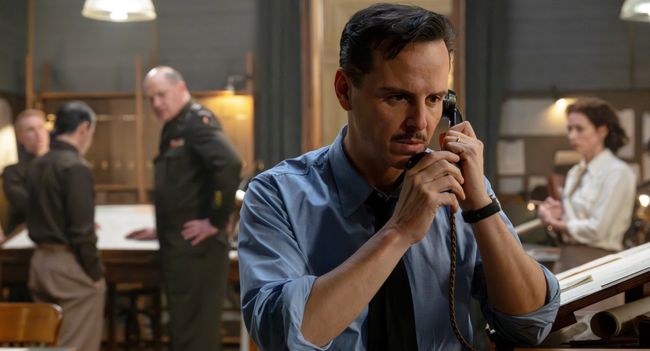
Andrew Scott delivers a gripping performance in Pressure, the WWII drama that puts a weather forecast at the centre of history
A single weather forecast could determine whether thousands of Allied troops lived or died — and in Pressure, Andrew Scott brings that extraordinary true story to the screen with a performance that makes the tension almost impossible to shake.
Anthony Maras’ WWII drama explores the little-known events behind one of the most consequential decisions of the Second World War: choosing the right moment for D-Day, the Allied invasion of Normandy that would ultimately change the course of the conflict.
The film draws on the real-life story of Captain James Stagg, the chief meteorologist who advised General Dwight D. Eisenhower during the crucial days leading up to the invasion.
A forecast with history hanging in the balance
The story begins in June 1944, just 72 hours before the planned Allied invasion.
Stagg, played by Andrew Scott, is suddenly taken away from his heavily pregnant wife in London and summoned to Eisenhower’s headquarters at Southwick House in Hampshire. His responsibility is extraordinary: he must provide a reliable forecast for the planned invasion date of Monday, June 5.
Today, checking the weather several days ahead is as simple as opening a phone app. In 1944, however, forecasting that far into the future was an enormous challenge, particularly with the unpredictable weather conditions across Northern Europe.
Stagg knows that getting the forecast wrong could have devastating consequences.
When he tells Eisenhower, “I’ll do my best,” the American commander makes it clear that his best is not enough. He needs certainty.
Eisenhower is still carrying the trauma of Operation Tiger, the disastrous D-Day rehearsal two months earlier that cost more than 700 lives. With the invasion approaching, there is no room for another catastrophic mistake.
Andrew Scott carries the pressure

Much of the film’s intensity comes from the confined world in which these decisions are being made.
For around 100 minutes, Pressure follows Stagg and the other military figures as they study maps, analyse data and argue over what the approaching storm could mean for the invasion. Rather than focusing on the battlefield itself, the film builds suspense around the people trying to determine whether the weather will allow the operation to go ahead.
Stagg soon finds himself at odds with Irving Krick, played by Chris Messina. The confident American meteorologist bases his prediction on historical climate data and believes the storm will pass in time.
The disagreement puts even greater pressure on Stagg, who must stand by his assessment while knowing the consequences of the final decision could extend far beyond the room.
Andrew Scott gives the role a striking intensity. His Stagg is blunt, focused and visibly burdened by the knowledge that his forecast could affect thousands of lives.
Brendan Fraser is equally compelling as Eisenhower, capturing the determination of a commander forced to make one of the most consequential choices of the war. His pre-battle speech is among the moments that gives the film its emotional punch.
A strong supporting cast

The central performances are supported by an impressive ensemble.
Kerry Condon plays Kay Summersby, Eisenhower’s secretary, bringing a warmer presence to the tense atmosphere surrounding military headquarters.
Damian Lewis appears as British General Bernard Montgomery, portraying him as a forceful figure eager to proceed with the invasion regardless of the weather conditions.
Together, the cast helps turn what might initially sound like a story about meteorological calculations into an absorbing human drama about responsibility, disagreement and impossible decisions.
When the weather becomes the battlefield

What makes Pressure unusual is the way it finds suspense in something as seemingly ordinary as the weather.
The film occasionally settles into a repetitive rhythm as Stagg, Krick and Eisenhower repeatedly debate the forecast. Yet the underlying tension remains, because every argument carries the weight of what is at stake.
Instead of placing the spotlight solely on soldiers and combat, the film draws attention to the strategists working behind the scenes — people whose calculations and decisions could alter the fate of an entire military operation.
That approach gives Pressure a different perspective on D-Day. Its drama comes not from explosions or battlefield action, but from the unbearable pressure surrounding a decision that could not be taken lightly.
At its heart, the film tells the story of a meteorologist who found himself at the centre of history, knowing that the weather he predicted could determine whether one of the largest and most dangerous seaborne invasions in history could proceed.
Pressure arrives in UK cinemas on September 9.