
The 1% Club’s Innocent-Looking Sentence Has A Brutal Hidden Trick — And The Spaces Between The Words Could Be Exactly Why You’re Missing The Answer
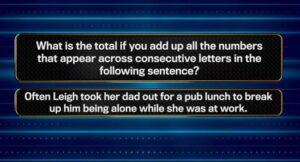
It looked like nothing more than an ordinary sentence.
But once the clock started ticking, this The 1% Club challenge had exactly the ingredients needed to leave contestants frantically scanning the screen for something they couldn’t immediately see.
Players were shown:
“Often Leigh took her dad out for a pub lunch to break up him being alone while she was at work.”
They were then asked:
“What is the total if you add up all the numbers that appear across consecutive letters in the following sentence?”
There was an immediate problem.
There were no visible numbers.
No digits. No equation. Nothing that appeared to require adding up at all.
And with only a limited amount of time to unravel the wording, the challenge was the kind that could easily produce that familiar The 1% Club tension: contestants staring intensely at the screen while viewers at home desperately scan the same sentence.
The biggest trap wasn’t difficult maths.
It was the way we’ve all been taught to read.
The Sentence Is Designed To Send Your Eyes In The Wrong Direction

Most people instinctively separate a sentence into individual words.
Often. Leigh. Took. Her. Dad.
And so on.
That is normally exactly what you’re supposed to do.
Here, it can sabotage you.
One of the easier clues is hiding inside the very first word:
ofTEN
There it is:
TEN
So that’s 10.
Spotting that could give a contestant the breakthrough they needed.
But it could also create another problem.
Once you’ve discovered TEN inside a single word, you might assume all the other numbers are hidden the same way.
They’re not.
One Tiny Phrase In The Question Changes Everything

The crucial wording is:
“across consecutive letters”
It doesn’t say:
“within individual words.”
That distinction is everything.
Suddenly, the spaces separating the words don’t necessarily matter.
Take:
LEIGH TOOK
Normally, there is absolutely no reason to read those two words as one continuous string.
But concentrate on the letters surrounding the space:
LEIGH Took
They spell:
EIGHT
That’s 8.
For anyone who had spent precious seconds hunting within individual words, this is the kind of reveal that can make an answer suddenly seem painfully obvious.
And now the entire sentence needs to be examined again.
The Puzzle Has Another Clever Misdirection
Further along comes:
ALONE
Hidden at the end is:
alONE
That’s another number:
ONE = 1
At this point, you’ve found numbers both inside words and across two words.

That mixture is what makes the challenge particularly effective.
You can’t rely on one method.
And there is still another number waiting near the end.
Look at:
AT WORK
Ignore the space:
aT WOrk
Those letters spell:
TWO
So that’s another:
2.
Now the challenge that initially appeared to contain no numbers whatsoever suddenly contains four of them.
And only after finding every one can you calculate the final total.
The Answer: 21
The hidden numbers are:
ofTEN = TEN = 10
lEIGH Took = EIGHT = 8
alONE = ONE = 1
aT WOrk = TWO = 2
Add them together:
10 + 8 + 1 + 2 = 21
So the answer is:
21
The genius of the puzzle is that TEN and ONE encourage players to search inside individual words.
But EIGHT and TWO demand that they ignore the spaces completely.
Once the trick is explained, the numbers suddenly appear impossible to miss.
Under studio pressure, however, those innocent little spaces between the words are exactly what can send your eyes in the wrong direction.