Three missing letters, two coloured lines and just one tiny overlap are all you need to crack this deceptively simple 5% puzzle.
The 1% Club is famous for making contestants forget everything they think they know about quiz shows.
There are no obscure capital cities to remember, no celebrity birthdays to memorise and no specialist subjects to study beforehand.
Instead, players need logic, observation and the ability to spot a simple pattern before the clock runs out.
And one 5% question perfectly demonstrates how the show can make something incredibly simple look completely baffling.
Contestants were confronted with what appeared to be a bizarre unfinished word:
Can You Work Out The Missing Letters?
The question asked:
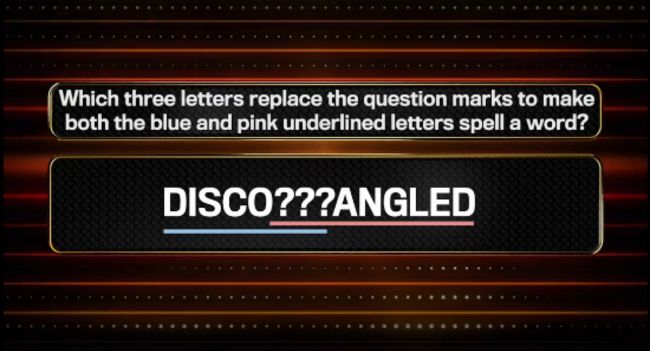
Which three letters replace the question marks to make both the blue and pink underlined letters spell a word?
On screen was:
DISCO???ANGLED
@1percentclubitv Blue and pink both need help #The1PercentClub #quiztime #quiztok ♬ original sound – The 1% Club
At first glance, it looks like somebody has simply smashed two unrelated words together.
But there is an important clue underneath the letters.
Part of the sequence is underlined in blue, while another section is underlined in pink.
The challenge is to replace all three question marks with the correct letters so that each coloured section becomes a legitimate word.
And because this was a 5% question, it was already deep into the difficult end of The 1% Club.
So, before reading any further, give yourself the same challenge.
Look at:
DISCO???ANGLED
You need exactly three letters.
The blue underline must produce one word.
The pink underline must produce another.
And there is one detail about the two coloured sections that makes the whole thing click.
The Question Marks Are A Clever Distraction
The natural instinct is to look at the entire string and try to turn:
DISCO???ANGLED
into one enormous word.

That sends you in completely the wrong direction.
There is no need for the complete line of letters to make sense as a single word.
Instead, the coloured underlines tell you which letters actually matter.
The beginning already gives you:
DISCO
Meanwhile, the ending gives you:
ANGLED
That leaves just three missing letters sitting between them.
Once those letters are inserted, the two coloured sections need to make two completely different words.
Still stuck?
There is another trap hiding in the way the question is presented.
The two answers are not completely separate.

They overlap.
And spotting that overlap is the key to solving the puzzle.
So What Is The Answer?
The three missing letters are:
S T R
Put them into the sequence and you get:
DISCOSTRANGLED
That still looks ridiculous if you try to read the entire thing as one word.
But follow the coloured underlines instead.
The blue section becomes:
DISCOS
And the pink section becomes:
STRANGLED
Both are valid words.
The clever part is the letter S.
It finishes DISCOS, but it also begins STRANGLED.
So the two coloured answers overlap on the same letter.
That gives:
DISCO + S = DISCOS
and
S + TR + ANGLED = STRANGLED
Three missing letters were all that was required.
Why The Puzzle Is So Easy To Overthink

This is exactly the type of question that makes The 1% Club so frustrating to play along with.
Nothing about the solution requires specialist knowledge.
Every letter needed to solve it is sitting directly in front of you, and both resulting words are familiar.
The difficulty comes from how your brain initially interprets the display.
Seeing DISCO???ANGLED encourages you to search for one continuous word or some relationship between DISCO and ANGLED.
But that isn’t the task.
The coloured lines are effectively telling you to read the same string in two different ways.
And the shared S is the tiny visual trick that unlocks everything.
Once STR is placed into the gaps, an apparently nonsensical string suddenly contains two perfectly ordinary words.
That is also what makes the solution feel so obvious after you’ve seen it.
The real challenge wasn’t knowing the words.
It was realizing where one word ends and the other begins — and that one letter belongs to both.