The 1% Club Viewers Cry Foul Over ‘Trick’ Question After Eight Players Are Eliminated — But One Tiny Detail Explains Why the Show’s Answer Was Right

The 1% Club sparked confusion among viewers after a deceptively simple-looking symbols puzzle eliminated eight contestants — and left people at home convinced the programme had given the wrong answer.
Host Lee Mack presented the challenge at the 15% stage of the ITV quiz.
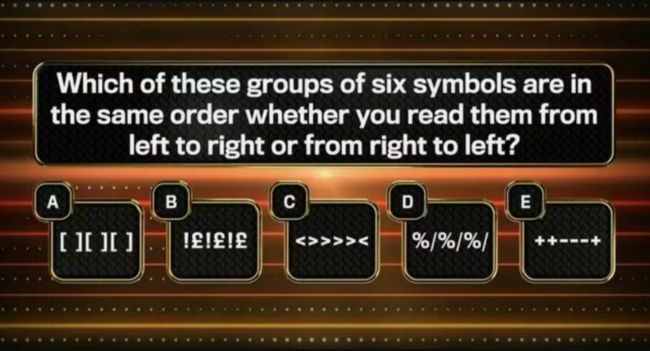
Contestants had to identify which group of six symbols remained in exactly the same order when read from left to right or from right to left.
When time expired, eight players were knocked out.
Mack revealed that the correct option was C.
But plenty of viewers were certain it should have been A.
The disagreement quickly spread online until eagle-eyed fans spotted the small detail that made all the difference.
The 15% question that caused chaos

The challenge asked:
“Which of these groups of six symbols are in the same order whether you read them from left to right or from right to left?”
At first glance, the task appeared to be about symmetry.
That assumption was exactly where many viewers went wrong.
After Mack announced C as the correct answer, social media filled with complaints from people who had selected A.
“I said A and I still think A. I don’t understand how it’s not,” one viewer wrote.
Another admitted they were completely baffled, while others demanded an explanation for why C worked.
But the puzzle wasn’t asking which sequence would look the same in a mirror.
It was asking whether the actual symbols appeared in the same order when read from opposite directions.
Why option A doesn’t work

The crucial detail involves the direction each symbol faces.
In option A, the brackets might initially appear to create a repeating or symmetrical pattern.
But a left bracket and a right bracket are different symbols.
When the sequence is read from the opposite end, their identities don’t magically reverse.
One viewer explained that reading A from left to right begins with one type of bracket, while reading it from right to left begins with the opposite bracket.
That means the sequence changes.
Visually, it can trick the eye into feeling symmetrical.
Logically, however, it fails the question.
Why C is the correct answer
Option C follows a different pattern.
The first symbol points left.
The four symbols in the middle point right.
The final symbol points left.
So its structure is effectively:
LEFT – RIGHT – RIGHT – RIGHT – RIGHT – LEFT
Now read exactly the same sequence starting from the opposite end:
LEFT – RIGHT – RIGHT – RIGHT – RIGHT – LEFT
Nothing changes.
That is why C satisfies the wording of the question.
As one viewer explained, the puzzle was “not about being mirrored” but about treating each symbol according to what it actually represents.
Another summed up the solution more simply: the first and last symbols point left, while the four between them point right, so the order remains identical whichever end you start from.
Eight contestants fall into the trap

The distinction was enough to eliminate eight contestants.
It also demonstrated one of the recurring traps behind The 1% Club.
The programme isn’t primarily testing obscure knowledge. Instead, its questions often depend on reading instructions extremely literally and resisting the answer that initially feels obvious.
Here, many viewers interpreted the challenge visually.
The question required them to interpret it sequentially.
Once that distinction is understood, C becomes much easier to defend.
But before viewers reached that explanation, the official answer had already caused plenty of frustration.
One word changes how the entire puzzle works

The key instruction was “read.”
Contestants weren’t being asked which collection of symbols was symmetrical or which would appear unchanged when reflected.
They had to start at one end, identify each individual symbol in order and then repeat the process from the other end.
Option A fails because reversing the reading direction changes which bracket appears first.
Option C survives because its sequence is identical in either direction.
It’s a tiny distinction, but it was enough to knock eight people out — and convince a large number of viewers that The 1% Club itself had made the mistake.
Only after fans broke the puzzle down symbol by symbol did the 15% question’s hidden trap become clear.