The 1% Club’s Brutal Limerick Question Wipes Out 14 Contestants — But Can You Find the One Word That Fits All Four Rules in 30 Seconds?

Fourteen contestants were knocked out of The 1% Club after a deceptively simple word puzzle turned into a nightmare. With just five possible answers and four rules to follow, the challenge looked easy enough. But when Lee Mack revealed the correct word, a huge number of players discovered they had fallen for the same trap. Could you have avoided their mistake?
ITV’s hit quiz show The 1% Club has become famous for making ordinary questions feel almost impossible under pressure.
Instead of testing general knowledge, the programme challenges 100 contestants to solve problems involving logic, language, observation and common sense.
Each player has just 30 seconds to answer, with the questions becoming progressively more difficult as the competition continues.
But one particularly tricky limerick puzzle left the studio reeling when 14 contestants were eliminated in a single round.
And the most frustrating part was that the answer was an everyday word.
The 30% Question That Sent 14 Players Packing

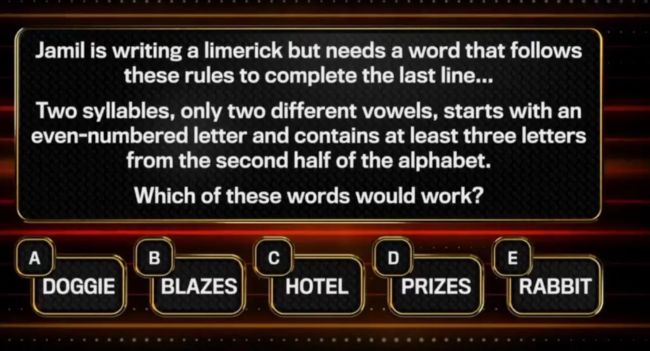
During the episode, host Lee Mack presented contestants with a challenge involving a character named Jamil, who was attempting to finish a limerick.
To complete the final line, Jamil needed a word that followed four specific rules.
The question read:
Jamil is writing a limerick but needs a word that follows these rules to complete the last line.
The word must:
- Have two syllables.
- Contain only two different vowels.
- Begin with an even-numbered letter of the alphabet.
- Include at least three letters from the second half of the alphabet.
Which of these five words would work?
A. DOGGIE
B. BLADES
C. HOTEL
D. PRIZES
E. RABBIT
The contestants had just 30 seconds to make their decision.

At first glance, the question appeared straightforward.
Every answer was a familiar English word, and the clues involved basic language skills rather than obscure knowledge.
But solving the puzzle meant checking all four conditions carefully.
And overlooking just one was enough to send a contestant home.
The Tiny Detail That Makes This Puzzle So Difficult
The first rule seems harmless enough.
Players simply need to identify a word with two syllables.
But the second clue introduces another complication: the word must contain exactly two different vowels.
That means contestants cannot simply count the total number of vowels.
They must identify how many distinct vowel letters appear.
The third rule requires a completely different approach.
The word must begin with an even-numbered letter.
In other words, its first letter must occupy an even position in the alphabet.
For example, B is the second letter, D is the fourth and P is the sixteenth.

Finally, contestants must check whether the word contains at least three letters from the second half of the alphabet, which runs from N through Z.
Individually, none of these tasks is particularly demanding.
But combining them while a countdown clock ticks away is another matter entirely.
And that is exactly where The 1% Club catches people out.
Fourteen Contestants Eliminated in One Brutal Round
As the remaining players studied the five options, the pressure was on.
They needed to make a decision before the 30-second timer expired.
When Lee revealed the result, 14 contestants had answered incorrectly.
Their elimination came during the 30% question, a stage where the challenge is already considerably harder than the early rounds.
Each eliminated player adds £1,000 to the potential jackpot, increasing the amount available to those who survive.
But for the 14 contestants who got the limerick question wrong, the chance of reaching the final was over.
The result showed how easily an apparently simple word puzzle could become a major obstacle.
There was no need for specialist knowledge.
No complicated equation.
And no obscure literary reference.
The correct answer depended entirely on noticing how the letters satisfied the rules.
Could You Have Solved It Before the Clock Ran Out?
Before revealing the answer, take another look at the five options:
DOGGIE — BLADES — HOTEL — PRIZES — RABBIT
Remember, the correct word must have two syllables, contain exactly two different vowels, begin with an even-numbered letter and include at least three letters from N to Z.
One option satisfies every condition.
The others fail at least one.
The challenge is to identify the correct word without getting distracted by the options that appear close.
And there is one particularly important detail involving the alphabet that makes the winning answer stand out.
The Correct Answer Revealed
The answer is D — PRIZES.
Here’s why.
First, PRIZES has two syllables when pronounced as PRI-ZES.
Second, the word contains exactly two different vowels: I and E.
Third, its first letter is P, which is the sixteenth letter of the alphabet.
Because 16 is an even number, it satisfies the third condition.
Finally, the word contains three letters from the second half of the alphabet: P, R and Z.
All three fall between N and Z.

That means PRIZES satisfies every rule.
The other options fail at least one of the conditions.
For example, DOGGIE begins with D, an even-numbered letter, and contains two different vowels, but it does not have three letters from the second half of the alphabet.
BLADES contains two different vowels, but B, L, A, D and E are all in the first half of the alphabet.
HOTEL begins with H, the eighth letter, but it has only two letters from the second half: O and T.
RABBIT contains three letters from the second half — R and two instances of T — but it has three different vowels: A, I and I actually represent only two different vowel letters. The problem is its first letter: R is the eighteenth letter, so it also meets that condition. However, RABBIT contains only two letters from the second half when counting distinct letters, R and T, whereas PRIZES has three distinct letters: P, R and Z.
That distinction is crucial to the intended solution.
PRIZES is the word that satisfies the puzzle’s intended requirement of three different letters from the second half of the alphabet.
Another Simple Question Knocked Out 23 Players
The limerick challenge wasn’t the only question in the episode to cause a major elimination.
Earlier, a 70% question involving left-handed and right-handed writing had also left contestants struggling.
Lee presented a sentence involving two men named John and Keith.
John wrote with his right hand, while Keith wrote with his left.
The question asked what the final word would be if Keith wrote the same sentence.
The solution was surprisingly straightforward.
The answer was BE.
Whether someone writes with their left hand or right hand does not change the order of words in a sentence.
Yet 23 contestants answered incorrectly and were eliminated.
The result sparked disbelief among viewers watching at home.
One viewer questioned how 23 people could have gone out, pointing out that being left-handed does not mean writing words in the wrong order.
Another suggested that the contestants had simply overcomplicated the question.
A third expressed astonishment that so many players had been eliminated by such a seemingly obvious answer.
The reaction highlighted one of the show’s most entertaining qualities.
Sometimes the contestants are defeated not because the question is too difficult, but because they assume the solution must be more complicated than it really is.
Why The 1% Club’s Word Puzzles Are So Dangerous
The programme’s format creates a unique kind of pressure.
One hundred contestants begin the competition, hoping to survive increasingly difficult rounds and eventually reach the final 1% question.
But every mistake can mean immediate elimination.
That makes even familiar words and everyday situations feel surprisingly intimidating.
The limerick challenge is a perfect example.
Contestants had all the information they needed.
The answer was right in front of them.
And every clue could be checked using basic alphabetical reasoning.
But the 30-second limit forced them to work quickly, and 14 players failed to find the intended answer.
The question also illustrates how important precise wording can be in a logic puzzle.
The distinction between counting individual letters and counting different letters matters, particularly when a word contains repeated characters.
That is exactly the kind of detail viewers need to watch carefully when playing along.
One Ordinary Word, Four Rules and 14 Eliminations
For audiences watching comfortably at home, it is easy to underestimate the pressure faced by contestants in the studio.
There is no opportunity to pause the clock.
No time to double-check every possibility indefinitely.
And no second chance once an answer has been submitted.
The limerick question required players to combine several simple observations into one correct decision.
Yet 14 contestants were unable to do it in time.
The 1% Club proved once again that the most frustrating puzzles aren’t always the ones filled with complicated mathematics or impossible riddles. Sometimes all it takes is five familiar words, four deceptively simple clues and a ticking clock to send a roomful of hopeful contestants home.
The 1% Club airs on ITV1 and is available to stream on ITVX.