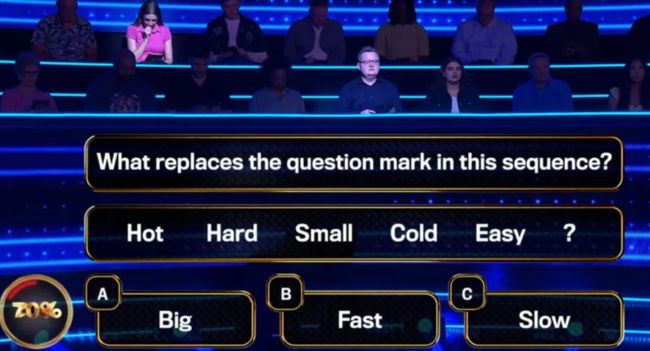

The 1% Club’s ‘Easy’ 70% Question Wiped Out 21 Contestants At Once — But Can You Spot The Ridiculously Simple Pattern They Missed?
It is only six ordinary words.
There are no complicated calculations, obscure facts or strange symbols to decode.
Yet when The 1% Club put this apparently straightforward sequence in front of its contestants, 21 players were eliminated in one brutal sweep.
The question appeared at the 70% stage, meaning it was supposed to be among the more accessible challenges of the night.
Contestants were shown:
Hot – Hard – Small – Cold – Easy – ?
They had three possible answers:
A: Big
B: Fast
C: Slow
With the clock ticking, more contestants than expected failed to spot the tiny connection hiding between the words.
So before reading any further, pick your answer.
Because once the trick is explained, it becomes almost embarrassingly simple.
A 70% Question Caused A Huge Wipeout

Hosted by Lee Mack, The 1% Club works differently from a traditional general-knowledge quiz.
Contestants do not need to remember historical dates, celebrity trivia or obscure facts.
Instead, the questions test logic, observation and common sense.
The game begins with challenges that a large percentage of people surveyed were able to solve, before progressing toward increasingly difficult puzzles and ultimately the notorious 1% question.
That means a 70% question arrives relatively early.
On paper, contestants should still be on comfortable ground.
This time, they weren’t.
When the answers were locked in, 21 contestants had either chosen incorrectly or failed to answer.
Their seats turned blue, transforming a large section of the studio in seconds.
Even Mack was struck by the scale of the elimination.
“Wow,” he said. “There are now more blue people than a Smurf convention.”
The Sequence Looks More Complicated Than It Is

The trap is trying to read the six words as one continuous sequence.
Hot. Hard. Small. Cold. Easy.
There is no obvious progression.
They do not increase or decrease in size.
They are not arranged alphabetically.
Their lengths do not immediately reveal anything useful.
And there is no clear relationship between “hot” and “hard,” or between “hard” and “small.”
That can send players searching for a much more complicated rule than the question actually requires.
Instead, the important words are separated from each other.
The first connects to the fourth.
The second connects to the fifth.
And the third must connect to the sixth.
Here’s The Pattern
Take the first word:
Hot
Now look three places ahead:
Cold
They are opposites.
Do exactly the same thing with the second and fifth words:
Hard → Easy
Again, opposites.
That leaves:
Small → ?
The missing word therefore needs to be the opposite of “small.”
And among the three available answers, only one works:
A: BIG
The complete pattern becomes:

Hot ↔ Cold
Hard ↔ Easy
Small ↔ Big
Nothing more complicated is happening.
No hidden numbers.
No word lengths.
No obscure linguistic trick.
Just three pairs of opposites arranged so that the first half of each pair appears before the second.
Why Did 21 Contestants Miss It?

That is exactly what makes questions like this so effective.
Once the answer is visible, the puzzle seems obvious.
But contestants do not receive the explanation first.
They have limited time, multiple possible answers and the pressure of knowing one mistake could end their game.
The sequence’s layout also encourages the brain to look for a relationship between neighboring words:
Hot → Hard → Small → Cold → Easy
Trying to force those words into a conventional sequence can quickly waste valuable seconds.
The solution only appears when you stop reading horizontally from one word to the next and instead connect positions 1 and 4, 2 and 5, then 3 and 6.
That small change in perspective turns a confusing sequence into three extremely familiar word pairs.
Lee Mack’s Reaction Said Everything
The mass elimination was particularly striking because of how The 1% Club visually represents contestants leaving the game.
Once someone is eliminated, their seat turns blue.
With 21 players disappearing on a single 70% question, the studio suddenly looked dramatically different.
That prompted Mack’s Smurf joke, but the result also demonstrated one of the show’s most entertaining quirks.
A question does not need to be mathematically difficult to destroy the field.
Sometimes the easiest concepts become the most dangerous when they are disguised in an unfamiliar way.
Early Questions Can Be Surprisingly Brutal
This was not the only occasion when a supposedly accessible question caused unexpected damage.
During the show’s Christmas special, more than a quarter of the contestants were eliminated by an 80% question.
Those moments underline what the percentages actually represent.
A 70% or 80% label does not guarantee that the person sitting in the studio will find the puzzle easy.
It simply reflects how the question performed among the people surveyed.
For the contestant staring at the screen with seconds disappearing from the clock, an “easy” question can still become the one that sends them home.
Could You Have Survived?
That is what makes this particular puzzle such a good test for viewers.
Look at it again after knowing the trick:
Hot – Hard – Small – Cold – Easy – Big
The pattern suddenly seems almost impossible to miss.
Hot and cold.
Hard and easy.
Small and big.
Yet 21 contestants failed to make that connection when it mattered.
And that may be the cleverest part of the question.
The 1% Club did not beat them with something only a genius could understand.
It beat them with three pairs of words almost everyone already knows.
They simply had to look at them in the right order.