Eight numbers.
No obvious mathematical progression.
And one empty space waiting to be filled.
It is exactly the sort of The 1% Club question that can make you start scribbling calculations almost immediately.
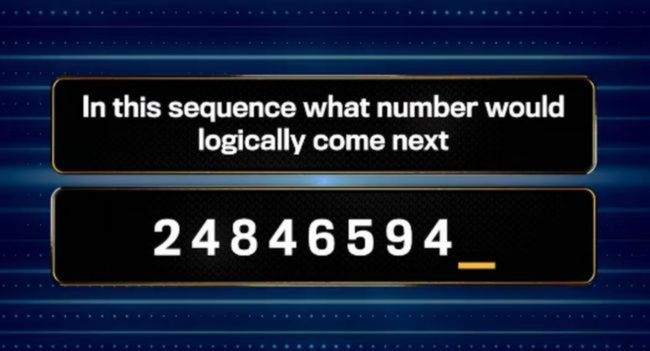
Players are shown the sequence:
2 4 8 4 6 5 9 4 _
Then comes the instruction:

“In this sequence what number would logically come next?”
At first glance, it looks like a classic number-pattern challenge.
Perhaps each digit is being multiplied or divided.
Maybe there are two alternating sequences.
Could 2 become 4, then 8, before the pattern suddenly resets?
And what exactly are you supposed to do with 6, 5, 9 and 4?
The longer you stare at the numbers, the more random they seem.
But that may be because you’re looking in entirely the wrong place.
Give yourself 30 seconds before scrolling down to the solution.
The Opening Numbers Immediately Send Your Brain Towards Maths
The sequence begins:
2, 4, 8…
That is almost irresistible.
Two doubles to four.
Four doubles to eight.
So naturally, your brain starts expecting 16.
Except the next number is:
4.
There goes that theory.
Perhaps the sequence works in groups.
Maybe 2, 4 and 8 form one set before 4, 6 and 5 begin another.
Or perhaps the digits correspond to something outside the sequence — dates, letters, months or positions in the alphabet.
There are dozens of possibilities.
And that is precisely why the puzzle works so well.
Because while you’re trying to discover what mathematical rule links the numbers, the question has already given you everything you need.
There’s A Much Bigger Clue Above The Sequence

Forget the digits for a moment.
Instead, read the wording at the top of the screen:
“In this sequence what number would logically come next?”
Nothing looks unusual about it.
It’s simply the instruction telling you what to do.
But what if the instruction isn’t separate from the puzzle?
What if it is the puzzle?
Start with the very first word:
IN
How many letters does it have?
2.
And what is the first number in the sequence?
2.
Coincidence?
Now look at the next word:
THIS
That contains:
4 letters.
The second number is:
4.
Suddenly, those supposedly random digits begin looking very different.
The 8 Is Where The Pattern Starts To Click

The third word is:
SEQUENCE
Count the letters.
S-E-Q-U-E-N-C-E
That’s:
8.
And the third number shown is also:
8.
So now we have:
IN = 2
THIS = 4
SEQUENCE = 8
Continue through the sentence and the whole puzzle starts revealing itself.
The next word is:
WHAT = 4
Then:
NUMBER = 6
WOULD = 5
LOGICALLY = 9
COME = 4
Which gives:
2 – 4 – 8 – 4 – 6 – 5 – 9 – 4
Exactly the sequence displayed on screen.
There is just one word left.
And that word determines the missing number.
The final word in the question is:
NEXT
And NEXT contains four letters.
Therefore the complete sequence is:
IN = 2
THIS = 4
SEQUENCE = 8
WHAT = 4
NUMBER = 6
WOULD = 5
LOGICALLY = 9
COME = 4
NEXT = 4
So:
2 4 8 4 6 5 9 4 4
And the missing number is:
4
There was no numerical progression at all.
No multiplying.
No alternating addition.
No complicated mathematical formula.
Every digit simply represents the number of letters in each consecutive word of the question itself.
That is what makes the puzzle so sneaky.
The moment you’re shown a string of digits, your brain wants to solve the numbers.
But in this case, the answer was sitting directly above them the entire time.