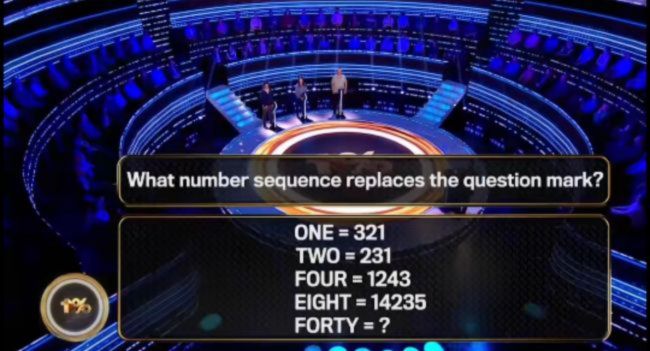
THE 1% CLUB PUZZLE THAT LOOKS LIKE MATH — BUT THE ANSWER IS HIDING IN THE WORDS

Five words. A handful of numbers. And one deceptively simple question.
At first glance, this The 1% Club puzzle looks like a straightforward number challenge:
ONE = 321
TWO = 231
FOUR = 1243
EIGHT = 14235
FORTY = ?
The task is to figure out what sequence should replace the question mark.
It sounds easy enough — until you try to work out why ONE becomes 321 and EIGHT becomes 14235.
The numbers don’t appear to follow any obvious mathematical pattern. You might start adding, multiplying, counting letters or looking for a connection between 1, 2, 4, 8 and 40.
But that’s exactly the trap.
The numbers aren’t really the important part. The letters are.
Give yourself 30 seconds before looking at the answer.
THE FIRST CLUE IS HIDDEN IN “ONE”
Start with: ONE = 321
There are three letters, so the three digits must somehow represent those letters.
Look at the letters: O – N – E
Now arrange them alphabetically: E – N – O
Their alphabetical positions within the word are therefore:
- E = 1
- N = 2
- O = 3
But the original word is written O-N-E.
So the corresponding numbers are: 3 – 2 – 1
That’s why: ONE = 321
THEN “TWO” CONFIRMS THE TRICK
The challenge is simple: what number sequence should replace the question mark?
Now look at: TWO = 231
The letters are: T – W – O
Alphabetically: O – T – W
So:
- O = 1
- T = 2
- W = 3
Put those rankings back into the original order T-W-O: 2 – 3 – 1
And suddenly: TWO = 231
The pattern is beginning to reveal itself.
FOUR MAKES IT EVEN CLEARER
Take: FOUR = 1243
Alphabetically, the letters are: F – O – R – U
Their rankings are:
F = 1
O = 2
R = 3
U = 4
But the original word is: F – O – U – R
So the numbers become: 1 – 2 – 4 – 3
Exactly as given: FOUR = 1243
AND EIGHT FOLLOWS THE SAME RULE
Now try: EIGHT = 14235
Alphabetically, the letters are: E – G – H – I – T
That gives:
E = 1
G = 2
H = 3
I = 4
T = 5
Return to the original spelling: E – I – G – H – T
And you get: 1 – 4 – 2 – 3 – 5
So: EIGHT = 14235
At this point, the final answer becomes much easier to spot.
SO WHAT IS FORTY?
The final word is: F – O – R – T – Y
Now put those letters into alphabetical order. They are already in alphabetical order: F – O – R – T – Y
That means their rankings are simply: 1 – 2 – 3 – 4 – 5
So the answer is: FORTY = 12345
The clever part of the puzzle is that it looks like a mathematical sequence, but there is actually no calculation involved.
The numbers simply show the alphabetical ranking of each letter within the word.
And because FORTY is already alphabetically ordered, the final answer is the unusually satisfying: 12345