

In anticipation of their North American tour, Italian Pop Opera trio Il Volo discuss their youthful success, the universality of the bel canto songbook, and how their collaborative shorthand has evolved over two decades onstage.
Il Volo have been packing stadiums since they were seventeen, and they have no intention of stopping.
A ‘popera’ trio comprised of Piero Barone, Gianluca Ginoble, and Ignazio Boschetto, the bambini prodigio were assembled for an Italian singing competition in the mold of The Three Tenors. Scoped by producer extraordinaire Jimmy Iovine, Il Volo became the first Italian act directly signed to an American label. In their near two decades on the global stage, the group has represented Italy in the Eurovision song contest, collaborated with Barbara Streisand and Andrea Bocelli, performed for two Popes and notched twelve albums.
Their devotion to reviving bel canto for a contemporary audience has earned them a devoted international following; as we discussed on Zoom in early March, North America will always occupy a special spot in their hearts.
Below is our conversation in anticipation of their North American tour, which kicked off with a Today Show appearance on April 9 and spans 18 venues through November 21.
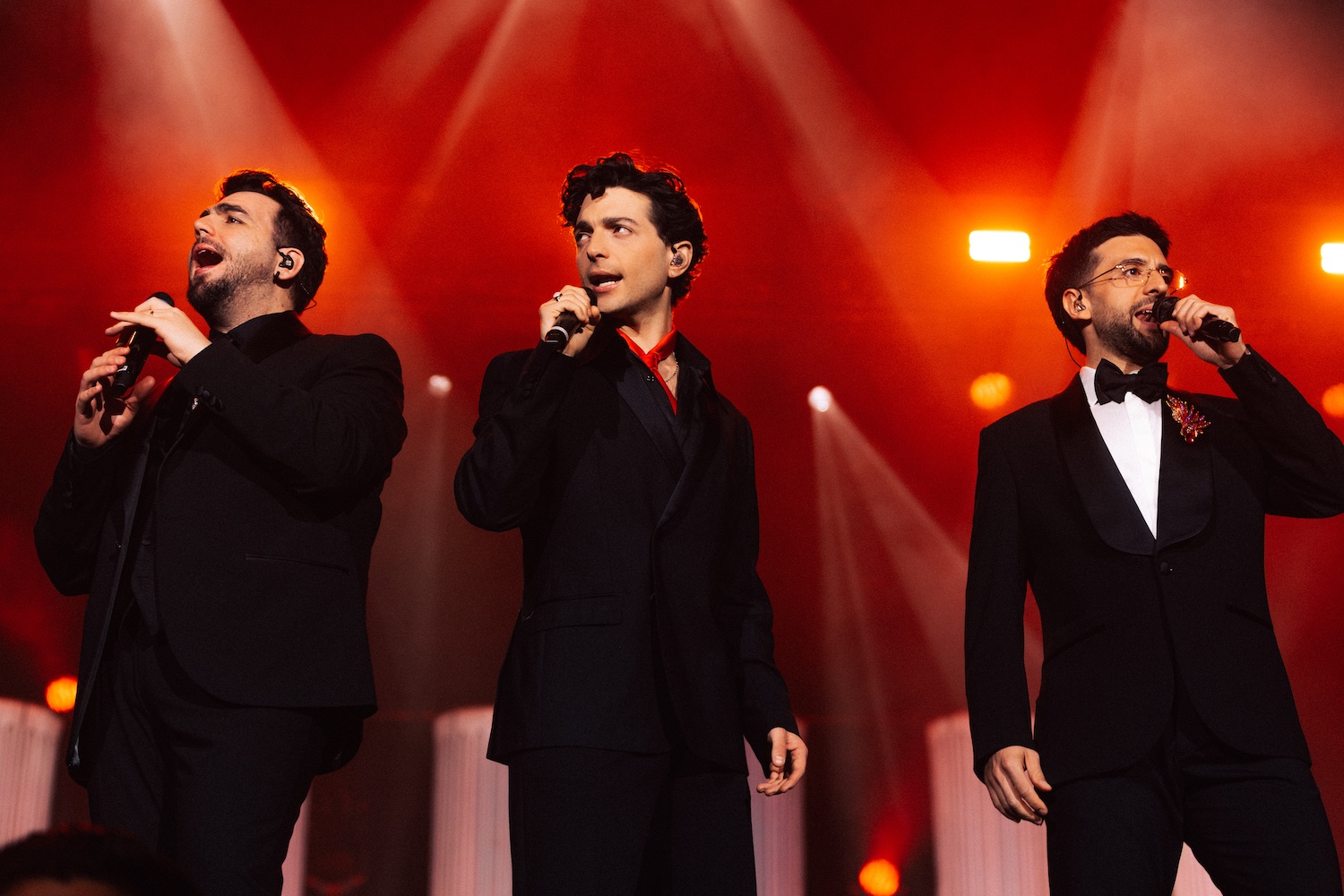
Nice! So typically, I do illustrated interviews, and what I’ve done is prepared a portrait of the three of you.
Il Volo: That is so cool! You have to bring it to us when we come to you, your city.
Absolutely.
Gianluca Ginoble: Thanks for making me so handsome! Who was the easiest one to draw?
Ah, it was easy! Interesting… I think you all have pretty distinctive profiles and facial hair! I referenced your most recent Christmas performance, and accentuated those features.
Speaking of Philadelphia, the current Pope is from right around here, and this past summer you performed for Pope Leo, which is not the first time you’ve performed for a Pope. What would you say is the difference between a typical show and preparing a performance for a world leader? How has your experience with that in the past informed how you approach a performance like that now?
Piero Barone: Of course, we are young. We started when we were 14, 15 years old, and we are seeing a kind of music that is easy to get into these kinds of events, for example, to sing Nessun Dorma. It’s a privilege. It’s something that, of course, at such a young age, we have the chance to bring in and to sing it for very important people, and of course, we sang for Pope Francis in Panama for the World Youth Day, and then we met Pope Leo a few months ago, and we performed World Youth Day in Rome, performing for the Jubilee. So, it was an honor, and it’s very funny, actually. He used to listen to our music. He said, “I know you guys. I really love your music”, and so we had the chance to chat a little bit and to talk about music and our passion, and it was really beautiful.
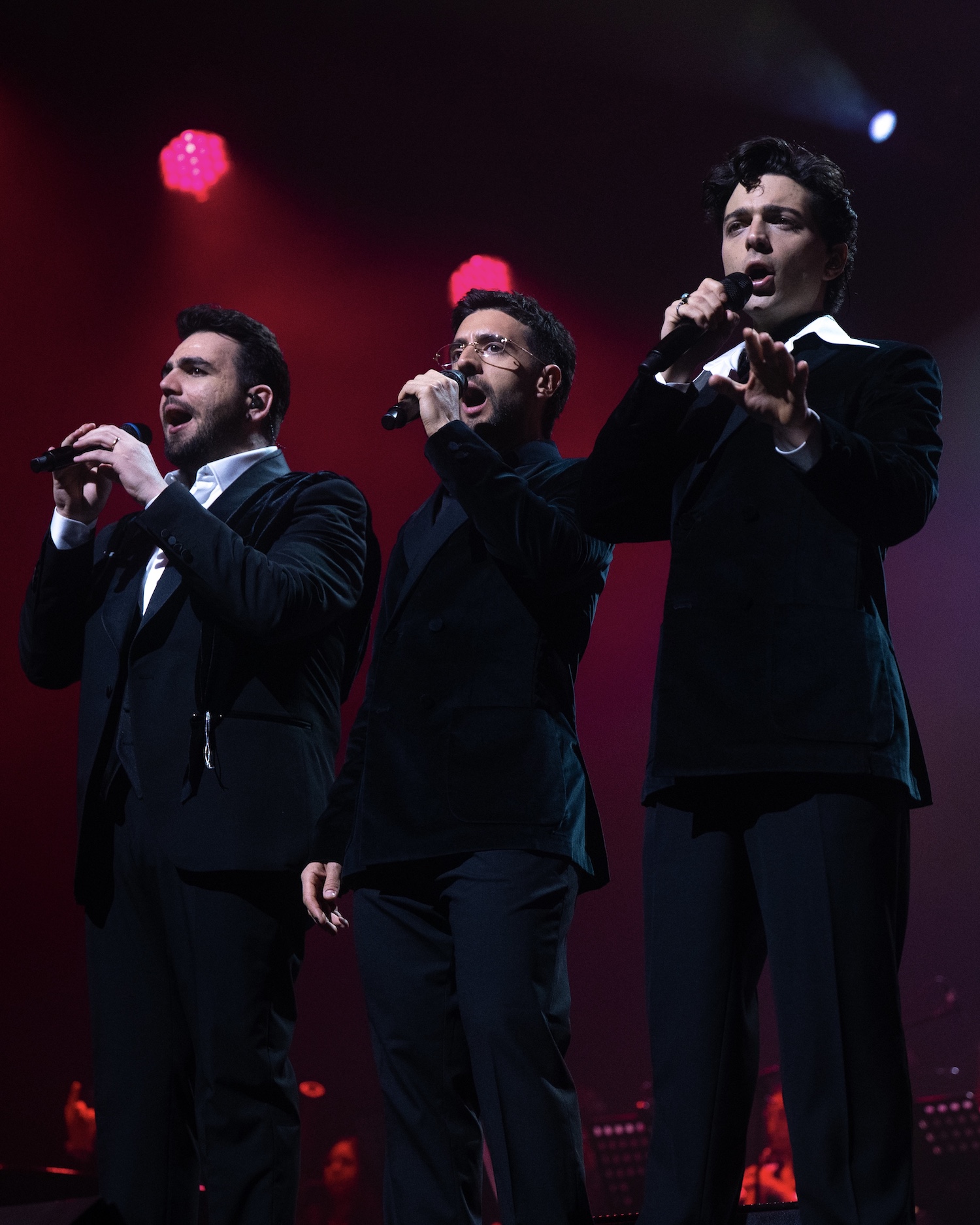
Wonderful! As you’ve said, you’ve been touring the States since you were teenagers. In your experience, do you have to vary your repertoire regionally? Are there specific venues and audiences that you remember that inform your approach as you’re touring?
Ignazio Boschetto: So, the States, we have to be, and we are very grateful to this country because it’s been the first country out of Italy who has welcomed us since the very beginning. So, we started touring in the States, and we started building our professional career in the States. And there are many cities, many venues where we’ve been very surprised when we perform since the very beginning, even though we didn’t know these venues. Like, I’m talking about Radio City Music Hall.
If you go to Italy and talk about Radio City Music Hall, everybody knows this place, even though they’ve never been. But we watched this venue in all the movies and everywhere. So, for us, it was like living a dream from the very beginning. Now, since it’s been a few years, like, let me say 10 years, we changed the approach to this job because at the beginning, it was like having fun singing. Now, it’s like a job where you wake up in the morning and you have to…
Piero Barone: No, we still have fun!
Ignazio Boschetto: Yes, we have fun. But it’s a job for us. We wake up in the morning, we sacrifice our private life because we are always on the road. But let me say that being in the States, it’s our second home. It’s like our second house in the States. So, that’s the reason why we are really happy to be back in April and doing all these concerts and singing for our American audience.
Am I right in saying that you were the first Italian artist that was signed directly to an American label?
Il Volo: Yeah!
So it becomes like a home away from home. And you’re performing in a lot of different languages, but there are standards that everybody knows. As you’re building up the setlists and you’re finding what material works over the years, what do you think it is about these songs that transcends the language barrier and it works so consistently through the years?
Gianluca Ginoble: I think that when people think about Il Volo, they think about Italy. And we realize that people want to hear us sing in Italian. But of course, we also realize that songs like “My Way,” it’s a must have on the list, on the show.
And our repertoire during these years has changed. Now it’s focused more on bel canto, of course. But I mean, also in America, in the USA, we love to sing songs like Smile, which we knew from the first album that we released.
And then we duetted with Barbara Streisand. So, of course, languages have a barrier to understanding. But what the people most need, it’s receiving something from the song.
And most of the time, it’s not the words, but it’s the song, the music.
Right. Especially with a full orchestra behind you.
Ignazio Boschetto: And the score is evocative. Because also, if someone loves opera, not everybody knows what their opera says. Also us, sometimes it’s really difficult to understand what Puccini wrote, because it’s in Old Italian.
That’s what happened also for our parents’ generation, also us, who was listening to Elvis Presley when they were young. If you ask my parents, did you like Elvis Presley? They loved Elvis Presley. But I’m sure they didn’t understand the words.
Like my father, he loved Bob Marley. But I didn’t know what the words said. Yeah, sometimes you could just capture a vibe and it breaks that barrier down.
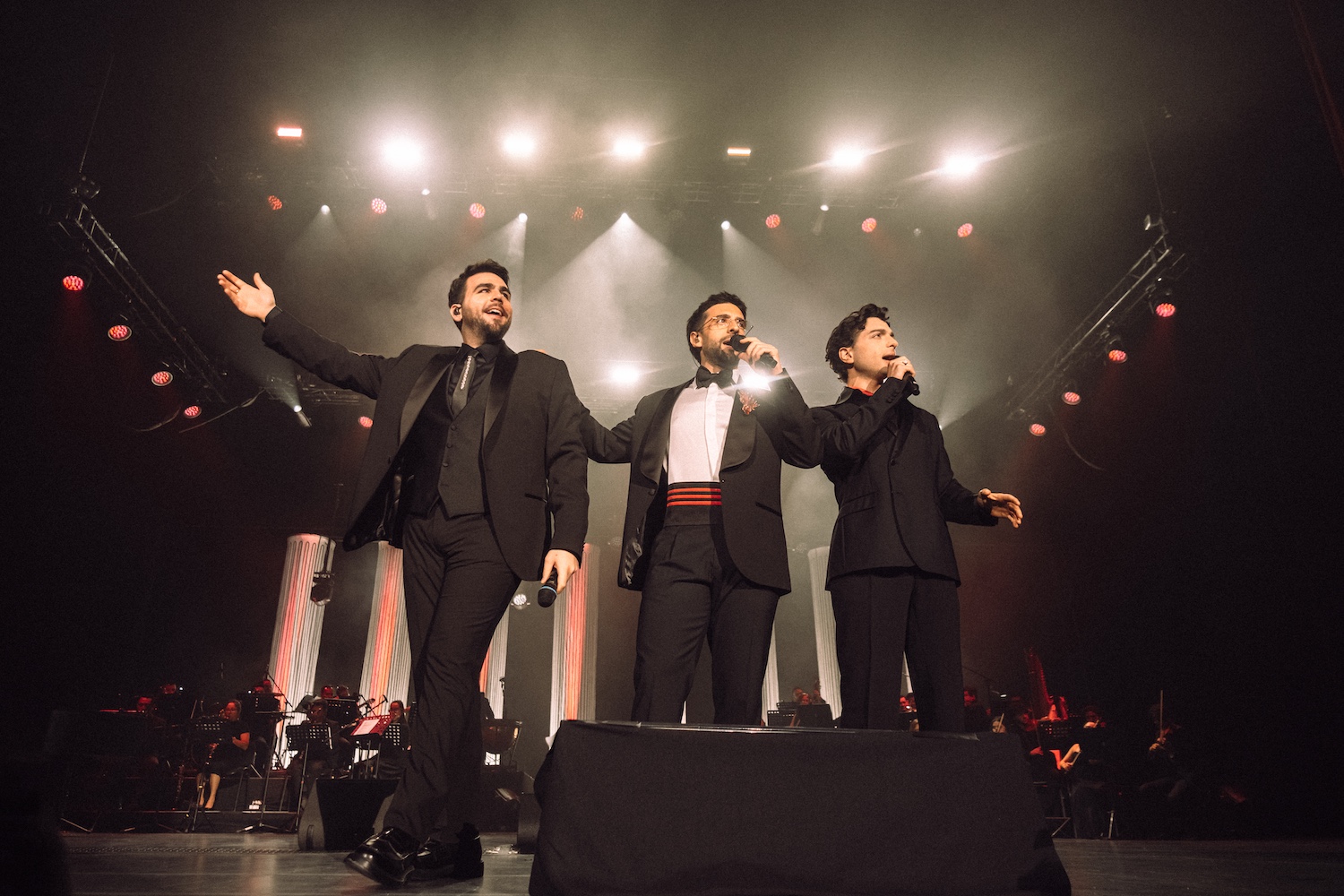
So one of the thrills of live performance is, when everything goes according to plan, it’s wonderful, but there’s that tightrope walk where glitches can happen. Since you’ve been working together so long, there must be this sort of symbiosis or a shorthand of, if something is off, there are three of you, so there has to be a way to sort of fill in that gap. Can you think of a time where something wasn’t quite right and you had to think on your feet, and that unspoken communication elevated a moment that could have been a mistake in a performance?
Piero Barone: That happens all the time. And probably this is the key of who we are now because we are a team.
And, of course, we work on ourselves as a person. But at the same time, we know how important it is to be a group and to send this kind of message. And, of course, sometimes on stage when something goes wrong, it’s just a look.
We look at each other and we really understand. We are just one person when we are on stage and this is very beautiful. So can you imagine 17 years together on stage, feeling the same emotions, looking at the same audience and singing the same songs? Something that makes us really, really strong together.
So we really understand each other and it’s very important to be a group and to send this kind of message also to the people. But let me tell you, we are lucky because no one of us has bad behavior. Behaving in interviews or in a personal environment, which in a group is very important. And so on stage, of course, talking about musically, we understand each other like we are just looking into each other with an unspoken sign, as you said.
But we are lucky because in interviews we don’t need to fix some mistake or the other because we always wanted to be an example for our generation.And of course for all generations. You can be cool and not be crazy.
Or, I mean, just a little bit crazy!
So that’s been just as important to you even when you were teenagers? Because you’ve been in the public eye for so long, so much of your lives have been recorded. Did you have to have conversations about that back then or was it a value that you were…
Ignazio Boschetto: No, we didn’t need to have a conversation about that. Look, we are coming from three very normal families with very strong values in life.And we know that what we reached in life, no one gave us.
We had to work. Our families put in all their efforts. They made many sacrifices to us beyond this situation today. And so we don’t want to waste the opportunity that life and God gave us.And so, I mean, we are very responsible guys. And not because we are famous, we need to let people think about it, but because we are.
“Luck meets opportunity.” And if you work hard to maintain that, obviously the results speak for themselves. In the vein of universal songs, last year, there was a documentary about the original “We Are the World.” And very early in your career, you participated in a remake of that track. I’m not sure how well-documented that experience was. But thinking back on your career, is there one song that you recorded, one performance that if you were to have the opportunity for it to be documented in that much detail, where someone’s talking about it 10, 15, 20 years later?
Piero Barone: That documentary was made very well. And there are things and moments that you live your life that you realize after many years.
And that thing you’re talking about is one of those moments that we realize many years after we made it. And it was fun because when we watched, like last year, two years ago, when we watched this documentary, it was something that you were watching and you said, “I lived that moment. I lived everything.”
So you saw Quincy Jones, Lionel Richie. The only person we didn’t meet was maybe Michael Jackson. But everything we watched in that documentary, it was everything that we lived 25 years later when they made “We Are the World” for Haiti.
The only thing I wish and I would love and I would like to live again the moment with more consciousness. How do you say? Knowledge. Exactly. So that’s the only thing I wish for myself and to ourselves. But when I watched this documentary, I really realized how privileged the three of us were being there with all these huge artists.