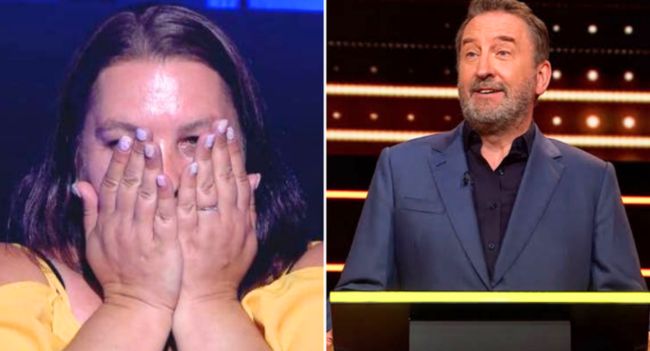
Five Contestants Reached The 1% Club’s £98,000 Final — but One Tiny Detail in the Question Eliminated Four of Them

Five contestants had survived almost an entire episode of The 1% Club. A £98,000 jackpot was within reach, and all that stood between them and the money was one final question.
At first glance, it hardly looked intimidating.
There were no complicated equations, no obscure facts to remember and no specialist knowledge required. Instead, host Lee Mack presented the finalists with a single sentence involving something everyone learns as a child: dotting the letter “i” and crossing the letter “t.”
Yet when the answers were revealed, the five finalists had produced totals ranging from 9 to 14.
Only one had spotted exactly what the question was asking.
Five Players Take On the £98,000 Question

The episode began with the usual 100 contestants attempting to work their way through increasingly difficult logic puzzles.
By the final stage, that enormous field had been reduced to just five players.
Each decided to continue rather than step away from the challenge, putting themselves in contention for the £98,000 prize.
Then Lee revealed the 1% question:
“If you are careful to dot all the small Is and cross all the small Ts, how many crosses on the small Ts and dots on the small Is are there in this particular sentence?”
It looked straightforward.
That was precisely the problem.
Rather than requiring a complicated calculation, contestants needed to concentrate on the exact wording in front of them and count what was actually there.
Under the pressure of a £98,000 final, four of the five got it wrong.
The Answers Were All Over the Place
Xem bài viết này trên Instagram
The finalists submitted answers ranging between 9 and 14.
The variation demonstrated how easily the sentence could send someone down the wrong path. The question sounded like an instruction about dots and crosses, but the solution was sitting directly inside the words themselves.
Lee eventually revealed the correct answer:
There were three lowercase “i” letters and 11 lowercase “t” letters in the sentence.
Three dots plus 11 crosses produced the required total of 14.
Only Lewis had counted correctly.
That meant four contestants who had survived every previous stage fell at the final hurdle, while Lewis became the sole player to crack the 1% question and walked away with the prize.
Why Such a Simple-Looking Question Was So Dangerous
This is exactly the kind of puzzle that makes The 1% Club different from a conventional quiz show.
The contestants were not being tested on history, geography or obscure trivia. Everything they needed was already displayed in front of them.
The difficulty came from knowing where to look.
The wording encouraged players to think about the familiar phrase “dot your i’s and cross your t’s,” while the actual task required them to ignore that distraction and carefully inspect the sentence itself.
And with tens of thousands of pounds at stake, slowing down enough to notice something so small becomes considerably harder.
The fact that four of five finalists failed only made Lewis’s answer more impressive.
Another Final Produced the Complete Opposite Result
The difficult £98,000 question followed another episode in which the final challenge produced a very different outcome.
On that occasion, three contestants reached the 1% question with £93,000 in the prize pot.
Rather than taking a smaller guaranteed amount, all three decided to attempt the final puzzle.
They were shown a system involving the letters L and R. Beginning from the same starting point each time, they were told that “LLL” represented A and “RRR” represented H.
They then had to decode:
LLR, LLL, LRR, RRL, RRL.
The answer was “BADGE.”
This time, every finalist solved it.
Each walked away with £31,000.
The question also divided viewers, with some considering it remarkably easy for a supposedly elite 1% challenge while others struggled even to understand how the puzzle worked.
That contrast illustrates the unpredictable nature of the programme.
A question that leaves one viewer completely baffled may seem obvious to another.
And sometimes the most innocent-looking puzzle can be the one that causes the most damage.

The 1% Club Rewards Attention More Than Knowledge
The format begins with 100 contestants and gradually eliminates players through questions designed around logic, observation and common sense.
As the percentage falls, the puzzles are intended to become increasingly difficult until the remaining contestants reach the question supposedly answerable by only 1% of people.
That structure means traditional quiz knowledge does not necessarily provide an advantage.
Instead, contestants have to notice patterns, interpret unusual wording and resist the temptation to overcomplicate apparently simple problems.
The £98,000 final demonstrated that perfectly.
Five people had already proved themselves capable of surviving the earlier rounds. Yet when presented with one ordinary-looking sentence, their answers stretched across five different numbers.
Four missed the crucial detail.
Lewis did not.
And after an entire episode of increasingly difficult puzzles, the difference between winning and losing ultimately came down to counting three small “i” letters and 11 small “t” letters correctly.