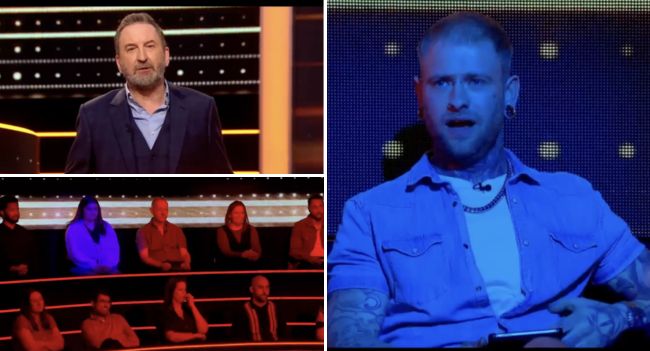
The 1% Club: 17 contestants are knocked out by a deceptively simple picture puzzle
The answer may look obvious once you see it, but could you spot it within 30 seconds?
A picture puzzle that appeared deceptively straightforward proved costly for 17 contestants on The 1% Club.
During the latest episode of Lee Mack’s ITV quiz show, players were shown a single word surrounded by circles and given just 30 seconds to work out what the image was trying to say. While some viewers watching at home considered the puzzle remarkably easy, a sizeable group of contestants failed to find the intended answer.

The challenge appeared during Saturday’s episode, which aired on 10 May 2025, at the 25 per cent stage of the competition.
Lee Mack introduced the puzzle to the remaining players, telling them: “Right we are at the 25 per cent stage now. In this puzzle, where are you going?”
The screen then displayed the word “ROUND”, with several coloured circles surrounding it.
The contestants had 30 seconds to interpret the visual clue and submit their answers.

Could you work out the phrase?
The trick was to look at the relationship between the word and the circles around it.
When the clock ran out, Lee revealed the intended answer: “round in circles.”
For 17 contestants, however, their answers were not close enough to keep them in the competition.
One of those eliminated was Harvey, who explained that he had answered “round the centre” instead.
His answer did not match the phrase the puzzle was looking for, and he was subsequently knocked out of the game.

Why simple questions can be difficult on The 1% Club
Unlike traditional quiz shows, The 1% Club does not primarily rely on general knowledge.
The format is built around logic, reasoning and common sense, with 100 contestants gradually eliminated as the questions become more difficult. ITV describes the show as one where contestants do not need to revise general knowledge in order to compete.
Each contestant begins with £1,000, while incorrect answers result in players leaving the competition and their money being added to the Prize Pot. The questions progress from ones that a large proportion of the public can answer to the final challenge, which is designed to be answered correctly by only 1 per cent of the population.
That format can make apparently straightforward questions particularly challenging. Contestants have to identify exactly what a puzzle is asking rather than simply recall a fact they already know.
The picture puzzle on Saturday’s show was a good example. The word ROUND was plainly visible, but the contestants still had to make the connection between the word and the circles surrounding it.

Viewers had very different reactions
Despite 17 contestants being eliminated by the question, some viewers at home were less impressed by its difficulty.
Several people took to X to comment on the episode, with some describing the questions as “easy.”
One viewer wrote that it was another “abysmally easy” episode of The 1% Club.
Another said the 5 per cent question had been so straightforward that it felt more like a 90 per cent question.
A third viewer pointed out that they had managed to answer the final question correctly for three consecutive weeks.
The contrasting reactions highlighted one of the quirks of the programme: a puzzle that seems immediately obvious to someone watching from the sofa can become considerably harder when a contestant has only seconds to interpret it.

Marc takes home £94,000
The episode eventually ended with Marc winning the £94,000 prize.
The picture puzzle was not the first time contestants had been caught out by something that looked deceptively simple on The 1% Club.
Previous episodes have also seen large groups of players eliminated by questions that viewers considered relatively easy. A separate picture involving a cat had also caused problems for some contestants.
The show’s premise is designed to test how people think rather than how much information they can remember. ITV’s format begins with 100 players and works towards a final question that only 1 per cent of the public would typically answer correctly.

And that is what makes the “ROUND” puzzle particularly interesting. There was no obscure fact to recall and no complicated calculation to perform. The challenge was simply recognising the phrase represented by the arrangement of the words and shapes.
With only 30 seconds on the clock, 17 contestants missed it.
So, if you had been sitting in the studio, would “round in circles” have come to you before the time ran out?