
Rewriting the Monster: How Netflix’s East of Eden Reclaims Cathy Ames as a Flesh-and-Blood Human

In John Steinbeck’s 1952 epic East of Eden, Cathy Ames is presented less as a person than as an elemental force—a “psychic monster” born with a defect of the soul, embodying an unholy synthesis of Eve and Lilith. But in Netflix’s limited series adaptation, creator Zoe Kazan and star Florence Pugh make a bold departure that has rankled literary traditionalists: they excavate Cathy’s malice from biblical allegory and ground it squarely in recognizable human trauma.
Rather than portraying a cartoonish embodiment of pure evil, Kazan and director Garth Davis construct a disturbing, psychologically grounded exploration of a survivor whose instincts for self-preservation have calcified into ruthlessness.
Unpacking the Roots of Malice

The series establishes its revisionist intent in Episode 2, titled simply “Cathy”. Where Steinbeck famously introduced Cathy through the murky gossip of a skeptical town and a narrator who repeatedly questions her innate humanity, the miniseries opens with a quiet childhood flashback:
-
The Stolen Innocence: A young Cathy, reading Alice in Wonderland in a field, is lured into the woods with candy by an older boy. While the production never depicts the assault explicitly, the visual of a child vanishing into the brush casts an inescapable shadow over every subsequent decade of her life.
-
The Architecture of Defense: Pugh interprets Cathy’s cruelty not as innate depravity, but as a rigid emotional fortress. Whenever past violations are dredged up, Pugh’s subtle facial shifts—a flash of nausea giving way to cold, unflinching composure—reveal a woman repulsed by her own vulnerability.
-
The Broader Cycle: Her path of destruction (burning her family home, abandoning her twin sons, shooting Adam Trask, and slowly poisoning Martha Plimpton’s madam Faye to take over the brothel) is not excused, but reframed. The cruelty becomes an extreme, inverted manifestation of power taken back from men who sought to control or consume her.
Confronting the Myth of the “Innate Monster”
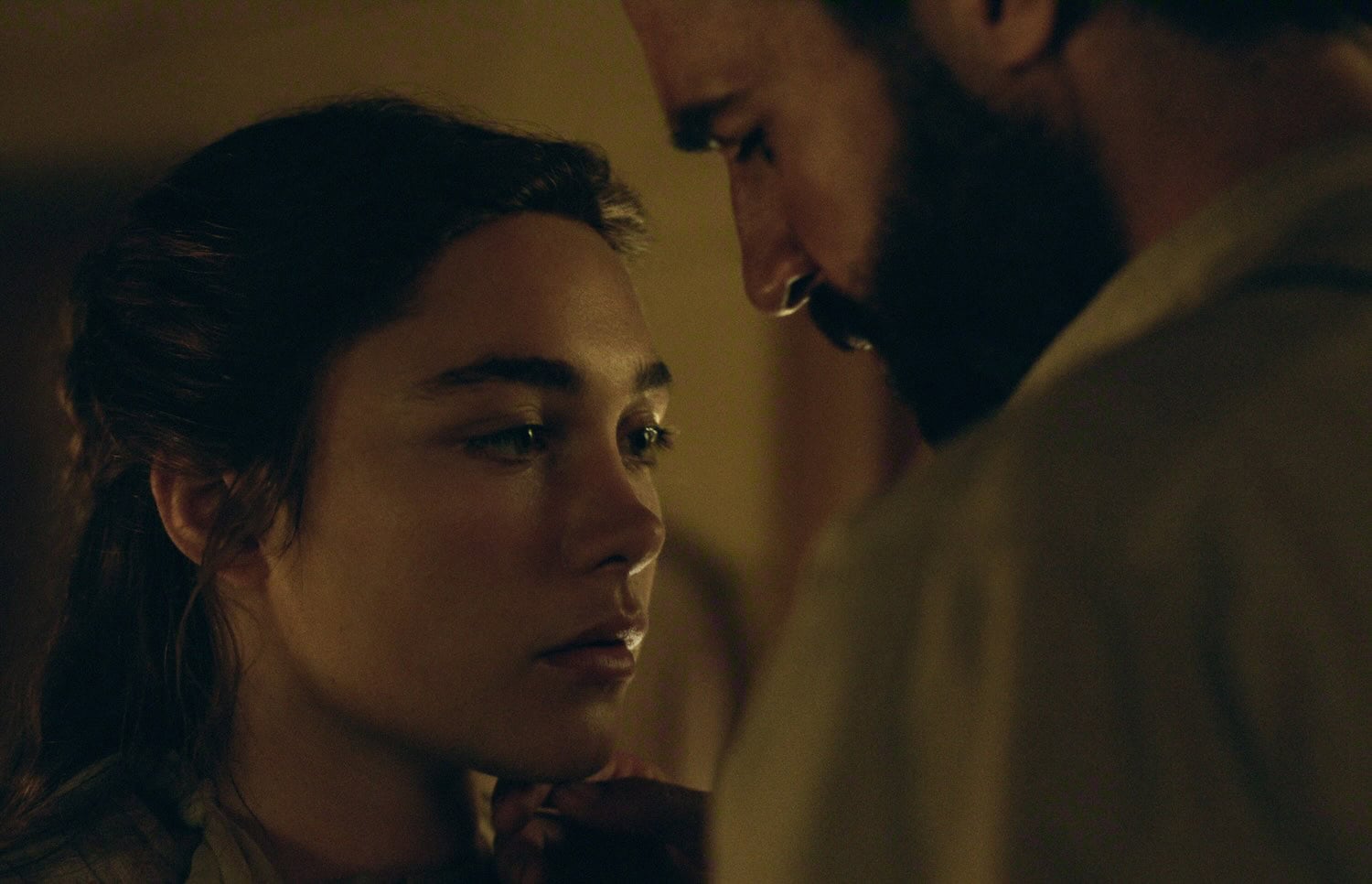
The contrast between page and screen crystallizes when Adam Trask (Christopher Abbott) tracks down Cathy years later at the brothel she runs under the alias Kate.
In Steinbeck’s text, Cathy boasts about manipulating her former Latin teacher into suicide, with Adam retorting that the man “must have been very sorry about something” to take his own life. The novel places the blame on Cathy’s siren-like influence. In the television adaptation, Cathy’s chilling reminder that the teacher “wanted to go to bed with me, a little girl” hangs heavy in the room. Instead of reflexively defending the man’s honor, Abbott’s Adam is forced to sit with the sordid truth behind Cathy’s bitterness, witnessing the rotten foundations upon which her villainy was built.
A Heritage Reimagined
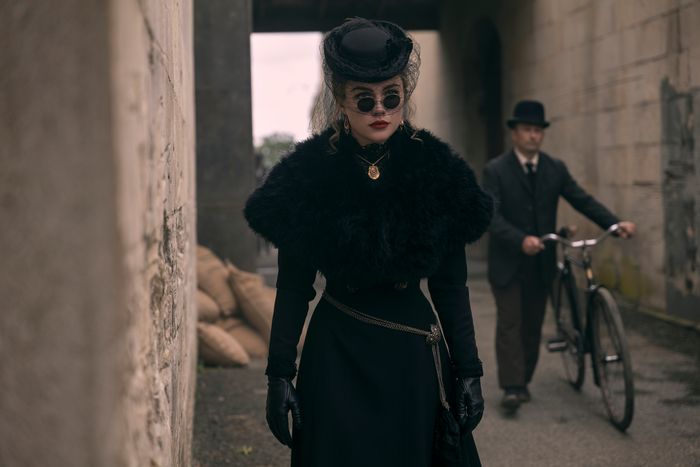
The creative shift carries profound cinematic lineage. Zoe Kazan’s grandfather, legendary filmmaker Elia Kazan, directed the landmark 1955 film adaptation starring James Dean, which bypassed the novel’s entire first half—and Cathy’s backstory—almost entirely.
By bringing Cathy Ames from the margins to the beating heart of the story, Zoe Kazan and Florence Pugh have crafted a polarizing but essential counter-narrative. The adaptation does not demand sympathy for Cathy’s atrocities, but it insists on something far more uncomfortable: demanding that we understand them.