23 Years Gone: Johnny Cash’s Final Tribute to June Carter Remains Heartbreaking
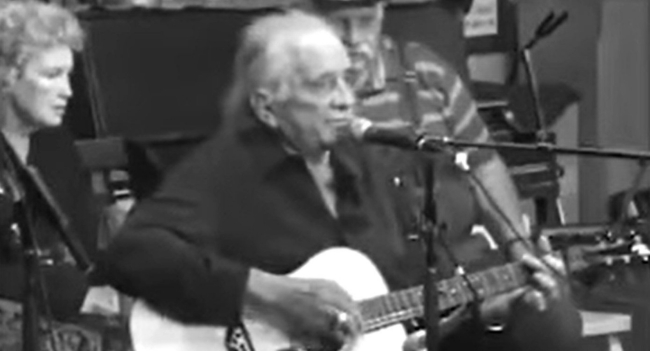
On July 5, 2003, Johnny Cash walked onto the stage at the Carter Family Fold in Hiltons, Virginia, for what would become his final public performance.
He was visibly frail and grieving the death of his wife, June Carter Cash, less than two months earlier. Yet he still picked up his guitar, greeted the audience with his familiar words, and performed several of the songs that had defined his career.
Then, before singing June’s “Ring of Fire,” Cash spoke about the woman who had been his wife, musical partner, and source of strength for 35 years.
His voice was weak. His body was failing. But his love for June was unmistakable.


The Arkansas Childhood That Shaped Johnny Cash
Johnny Cash was born on February 26, 1932, in Kingsland, Arkansas, during the depths of the Great Depression. He grew up in a poor farming family, and the hardships of rural Arkansas became an important part of the worldview he carried throughout his life.
The themes that later defined his music were already present in those early years: faith, hardship, family, death, redemption, and the struggles of ordinary people.
One of the most devastating experiences of Cash’s childhood came when his older brother Jack was killed in a table saw accident. Jack was only 14 and was remembered as a hardworking, deeply religious boy who read the Bible every night and had hoped to become a minister.
Johnny was just 12 when he helped dig his brother’s grave. The loss stayed with him for the rest of his life and became an important part of the spiritual perspective that ran through his music.
Cash eventually joined the United States Air Force and served as a radio intercept operator in Germany. While stationed there, he intercepted Soviet communications and was reportedly among the first Americans to learn of Joseph Stalin’s death on March 5, 1953.
After leaving the Air Force, Cash settled in Memphis, Tennessee, and began pursuing music seriously.
In 1955, he started recording for Sun Records, entering the same musical world that included Elvis Presley, Jerry Lee Lewis, and Carl Perkins. Songs such as “Cry! Cry! Cry!”, “I Walk the Line,” and “Folsom Prison Blues” quickly established the deep, unmistakable voice that would become one of the most recognizable sounds in American music.


A Career Built on Contradictions
Cash’s life was rarely simple.
As his fame grew, he battled addiction to alcohol and pills and endured serious personal struggles. At the same time, his music increasingly reached beyond the boundaries of traditional country.
He sang about his Christian faith, prisoners, Native Americans, working people, loneliness, guilt, death, and redemption. His sympathy for people living on the margins became one of the defining characteristics of his work.
His performances inside prisons became especially important to his legacy. The live recordings from Folsom Prison in 1968 and San Quentin in 1969 captured Cash connecting with incarcerated audiences in a way few mainstream artists had attempted.
By then, Cash had become much more than a country star. He had developed into one of the most important voices in American music.
His later career brought another remarkable transformation.
Working with producer Rick Rubin, Cash began the American Recordings series, stripping his performances down and allowing his aging voice and life experience to become central to the music.
He recorded traditional folk and gospel material alongside songs written by contemporary rock artists. Among the most famous was his 2002 version of Nine Inch Nails’ “Hurt,” a stark performance that became one of the defining recordings of the final years of his life.


How Johnny Cash and June Carter First Met
Long before that final performance, Cash and June Carter had become one of country music’s most enduring couples.
They first met in 1956, around the time of Cash’s Grand Ole Opry debut. June was already part of the legendary Carter family, while Cash was beginning to make a name for himself following his early success at Sun Records.
Both were married to other people at the time. Cash was married to Vivian Liberto, while June was married to Carl Smith, though their marriage ended that same year.
Even so, Cash and June immediately developed a strong connection.
June later remembered being captivated by Cash’s eyes and the commanding presence he brought to the stage. She recalled that he could hold an audience with little more than his guitar, bass accompaniment, and an unmistakable presence.
Their relationship grew over the following years.
Cash toured with the Carter family during the 1960s, and June remained close to him as his personal life became increasingly difficult. Cash’s first marriage eventually ended in divorce, while his dependence on alcohol and pills became more destructive.
He was arrested several times during the decade.
June Carter, along with Mother Maybelle Carter and her husband Ezra Carter, eventually moved in with Cash in an effort to help him overcome his addiction.
June cared deeply about Cash, but she refused to marry him while he was still using drugs.
That changed on February 22, 1968.
During a concert at the London Gardens in London, Ontario, Canada, Cash proposed to June onstage. She accepted, and the couple married a week later in Franklin, Kentucky.
Their marriage would last for the next 35 years.


June Carter’s Death Devastated Johnny Cash
June Carter Cash died on May 15, 2003, at the age of 73, following complications from heart valve replacement surgery.
For Johnny, the loss was devastating.
He tried to cope in the way he knew best: by continuing to work.
According to Marty Stuart, Cash’s son John Carter Cash called him the day after June’s death to say that his father wanted to return to the studio.
Rick Rubin later recalled just how badly Cash was struggling with the loss. Cash told him that he needed to keep working because, without something to occupy him, he felt he would die.
Cash continued recording even as his health deteriorated.
He had already been diagnosed with autonomic neuropathy associated with diabetes, and by the summer of 2003 he was physically extremely fragile. Yet he still agreed to appear at the Carter Family Fold.
Johnny Cash’s Final Public Performance
The Carter Family Fold in Hiltons, Virginia, was an especially fitting place for Cash’s final appearance.
Founded by Jeanette Carter, the daughter of Sara and A.P. Carter, the venue was dedicated to preserving traditional country music and bluegrass and was deeply connected to the Carter family legacy.
On July 5, 2003, Cash took the stage for a roughly 30-minute performance.
He was in a wheelchair and needed assistance getting to the chair positioned in front of the microphone. His voice was noticeably weaker than it had been during the height of his career.
But when he greeted the crowd with his familiar introduction, “Hello, I’m Johnny Cash,” there was still something unmistakably Johnny Cash about the moment.
His set included “Folsom Prison Blues,” “I Walk the Line,” Kris Kristofferson’s “Sunday Mornin’ Comin’ Down,” “Ring of Fire,” “Angel Band,” “Big River,” and “Understand Your Man.” The latter was particularly notable because Cash had not performed it live in approximately 25 years.
But the most emotional moment came before “Ring of Fire.”


A Final Tribute to June
Before beginning the song, Cash paused to speak about June.
He told the audience that he felt her presence with him that night and described their connection as something that continued between earth and heaven. He imagined that she had come down for a brief visit, giving him the courage and inspiration she had always given him.
Cash then thanked God for June and told the audience how deeply he loved her.
Finally, he introduced “Ring of Fire,” a song closely associated with both of them and one that June Carter had co-written with Merle Kilgore.
The performance carried an emotional weight that was impossible to miss. Cash’s health was failing, and he had lost the woman who had stood beside him through decades of triumph, addiction, recovery, family life, and music.
Yet he was still there, holding his guitar and singing a song connected forever to the woman he loved.


The performance continued with “Angel Band,” followed by “Big River” and “Understand Your Man.” When Cash finished, the audience gave him a standing ovation.
He would never perform publicly again.
Johnny Cash’s Final Months
Cash lived for only a little longer.
After his final public performance, he continued working and recording. Songs from these final sessions would later appear on posthumous releases, including American V: A Hundred Highways.
On September 12, 2003, Johnny Cash died at the age of 71.
His death came only four months after June’s.
Their final months together in life had been separated by June’s death, but Cash’s last appearance onstage made clear how much of her remained with him. He went to the Carter Family Fold carrying his grief, his guitar, and the songs that had connected them for decades.
Twenty-three years later, the footage of that performance remains difficult to watch.
There is no elaborate production and no attempt to hide Cash’s physical condition. There is simply an aging legend, sitting before a microphone, doing what he had done for most of his life.
And before singing “Ring of Fire,” he made sure the world knew who was still on his mind.
June Carter.