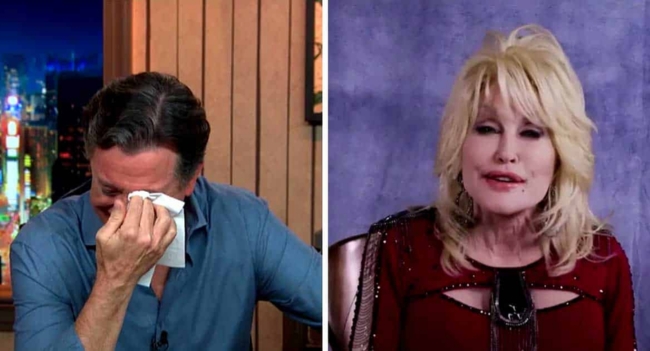
Dolly Parton’s impromptu song brings Stephen Colbert to tears: ‘I better hush before you cry yourself to death’
Dolly Parton needed only a few lines of an old folk song to leave Stephen Colbert wiping tears from his eyes.
During her October 20, 2020 appearance on The Late Show with Stephen Colbert, the 74-year-old country music legend was discussing the songs she grew up hearing from her mother, Avie Lee, when she suddenly began singing Bury Me Beneath The Willow.
The moment was completely unplanned. Parton sang the traditional ballad a cappella, recalling the story of a young woman whose fiancé leaves her before their wedding. Colbert listened quietly before removing his glasses and reaching for a tissue as the song continued.


A song from Dolly’s childhood
Parton explained that Bury Me Beneath The Willow was one of many old songs her mother used to sing around the family home.
Avie Lee Parton raised 12 children with Dolly’s father, Robert, in rural Tennessee. She died in 2003 at the age of 80.
Dolly remembered her mother as a gifted singer who often performed without any musical accompaniment.
“Mama was a good singer too,” Parton recalled, explaining that Avie Lee would sing a cappella and that many of the traditional songs she knew were deeply sad, sometimes even “plum pitiful.”
Among them was Bury Me Beneath The Willow, a song about a young woman whose boyfriend leaves her at the altar. In the story Parton remembered, the woman eventually dies and asks to be buried beneath a willow tree so that the man might know where she is and perhaps mourn her.
Parton then demonstrated the song for Colbert, singing several lines before noticing his reaction.
She paused to ask whether he was crying, then quickly returned to the performance.


‘I better hush’
By the time Parton finished the short rendition, Colbert was visibly emotional.
With his glasses off and tears in his eyes, the host tried to compose himself. Parton responded with the lighthearted humor that has long been part of her public persona.
“I better hush before you cry yourself to death and you can’t finish this show,” she joked.
Colbert laughed as he wiped his eyes and explained that, like many Americans at the time, he was under considerable stress. He later described the performance as beautiful and said Parton had caught him at an emotional “tripwire.”
Parton understood the reaction. She explained that the same songs had made her and her siblings cry when their mother sang them.
“Mama would cry. We’d cry,” she recalled, reflecting on the emotional power of those old songs.
For Parton, the exchange was about more than making an audience member emotional. The performance brought one of the musical memories of her childhood directly into the conversation, connecting a traditional folk song with the mother who had helped shape her love of music.
The musical influence of Avie Lee Parton
Parton had spoken for years about the influence her mother had on her independence and creativity.
In an interview with Family Circle in the 1970s, she described Avie Lee as the daughter of a Fundamentalist preacher and recalled how strictly her mother had been raised. Women in the family were not permitted to dance or wear bright clothing, and they were expected to keep their hair long.
Avie Lee married Dolly’s father, Robert, when she was 15 and he was 17. According to Dolly’s recollection, one of the first things her mother did after marrying was cut her hair.
Because Avie Lee was so young when she started raising her family, Parton said her mother essentially grew up alongside her children. As she developed a sense of her own identity, she encouraged her children to develop theirs as well.
Parton also remembered the difficult circumstances of her childhood, but said her mother had a gift for making life feel beautiful despite having very little.
Avie Lee encouraged imagination, and music was an important part of family life. Her influence remained evident in Parton’s songwriting and in the traditional songs she continued to remember decades later.


The story behind ‘Bury Me Beneath The Willow’
Bury Me Beneath The Willow is an old folk song that was first recorded in 1927. Over the years, it became associated with bluegrass and traditional American music and was performed by artists including the Carter Family, Almeda Riddle and the Stanley Brothers.
Its mournful story clearly stayed with Parton from childhood. She later performed the song herself on her ABC variety show in the 1970s, joining Linda Ronstadt and Emmylou Harris as a trio.
Decades later, she brought the song back to life in a very different setting: a conversation with Colbert about the music she heard growing up.
The performance was brief, but its emotional impact was immediate. Colbert’s reaction gave Parton an opportunity to explain why songs from her mother’s generation remained so powerful to her.


Promoting Songteller
Parton appeared on The Late Show while promoting her forthcoming book, Dolly Parton, Songteller: My Life in Lyrics, which was scheduled for release on November 17, 2020.
The book, written with Robert K. Oermann, looks back at Parton’s songwriting career and the stories behind more than 175 of her songs. It combines lyrics with Parton’s own memories and reflections on the music that shaped her life.
That made the conversation with Colbert particularly fitting. What began as a discussion about songwriting quickly turned into a personal recollection of the music Parton heard as a child.
And when she started singing Bury Me Beneath The Willow, the story behind the song became as important as the song itself: a memory of Avie Lee, the family home in rural Tennessee, and the old melodies that could still bring Dolly Parton and her siblings to tears.
For a few quiet moments on late-night television, one of those childhood songs did exactly what Parton remembered it doing all those years ago. It moved someone to tears.