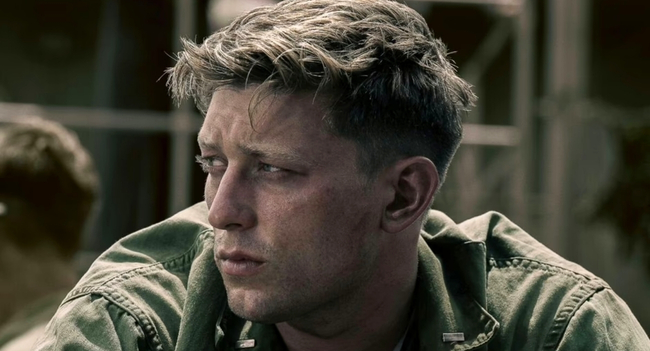
Netflix’s The Mosquito Bowl brings a remarkable World War II story to the screen


Fans of hard-hitting war dramas such as Saving Private Ryan have a new film to put on their radar. Netflix has unveiled the first look at The Mosquito Bowl, an upcoming World War II drama from director Peter Berg that tells the true story of four college football stars who traded promising athletic careers for military service.
The film is based on Pulitzer Prize-winning author Buzz Bissinger’s 2022 nonfiction book, The Mosquito Bowl: A Game of Life and Death in World War II. It follows four of America’s top college football players in the aftermath of the attack on Pearl Harbor, as they enlist in the Marines and find themselves heading toward one of the bloodiest campaigns of the Pacific War.
The Mosquito Bowl will arrive on Netflix on November 25, 2026, following a limited theatrical release beginning October 30.
Four football stars leave fame behind


At the center of the story are John McLaughry, Bob Baumann, Tony Butkovich and David Schreiner, four gifted football players whose lives change dramatically after the United States enters World War II.
Nicholas Galitzine plays McLaughry, a quarterback for Brown University who was coached by his father. Bill Skarsgård portrays Baumann, who played for the University of Wisconsin. Ray Nicholson takes on the role of Purdue star Tony Butkovich, while Tom Francis plays Wisconsin player David Schreiner, who was Baumann’s teammate.
The men were part of a remarkable group of football players who enlisted during the war. Their athletic careers gave way to Marine training and, eventually, the brutal realities of combat.
Netflix describes the story as one about young men being pulled out of an idealistic youth and into the violence of World War II, while exploring the cost of war and the bonds formed between those who experience it together.
The real story behind The Mosquito Bowl
The film draws directly from Bissinger’s book, which chronicles the college football players who joined the military and the extraordinary game that brought many of them together before the Battle of Okinawa.
The real Mosquito Bowl was played on Christmas Eve in 1944 on Guadalcanal, when the 4th and 29th Marine Regiments faced each other. The game brought together an extraordinary collection of college football talent at a moment when the players were preparing for the invasion of Okinawa.
Of the 65 players who took part, 15 were later killed at Okinawa, giving the game a tragic significance that would only become clear after the war.
That contrast between a familiar game and the violence waiting ahead is at the heart of the story. For the players, football briefly offered a return to something they knew before they were sent into battle.
Peter Berg wanted the film to feel authentic
Director Peter Berg, known for Friday Night Lights and Lone Survivor, has approached the project with an emphasis on staying close to the experiences of the real men.
Speaking to Netflix’s Tudum, Berg said the production was representing something larger than the filmmakers themselves and paying tribute to Marine Corps personnel who sacrificed their lives in 1944 and 1945.
That commitment to realism extended to the cast.
Nicholas Galitzine said the actors performed much of the action themselves, with limited reliance on stunt doubles. He described working around explosions, burning trees and flames as an experience unlike anything he had previously encountered in his career.
Ray Nicholson also emphasized the responsibility involved in portraying real people. For the cast, the goal was to work as hard as possible while remembering that the characters they were portraying had actually lived through the events.
The four leading actors also developed a close bond during months of preparation and filming. Bill Skarsgård described the connection as a combination of the camaraderie found in football, the Marine Corps and the cast’s own experience making the film.
Filmed in Australia
Although the story takes place during World War II in the Pacific, production was filmed in Australia, including locations in Queensland and northern New South Wales.
The Australian landscape was used to portray everything from Marine training grounds to locations representing the Pacific Theater. Berg praised Queensland’s scenery during production, describing its landscapes as particularly well suited to the story.
For Tom Francis, who joined the film after appearing on Broadway in Sunset Boulevard, the production was also his first film role. He described the five-month experience as particularly significant, saying the cast entered the movie as boys and left as men.
A cast built around the four real-life players
Each of the central actors has a specific connection to the football history behind the story.
Nicholas Galitzine as John McLaughry
McLaughry was a Brown University quarterback who played under his father, and his leadership on the football field becomes an important part of his character.
Bill Skarsgård as Bob Baumann
Baumann was a University of Wisconsin player known for his imposing personality and physical presence.
Ray Nicholson as Tony Butkovich
Butkovich was a Purdue star and one of the standout offensive players of his era, having established records during his college career.
Tom Francis as David Schreiner
Schreiner played for Wisconsin alongside Baumann and is portrayed as a thoughtful, strategic player.
Together, their stories provide the film with its central link between college football, military service and the devastating reality of the Pacific campaign.
When can you watch The Mosquito Bowl?
Netflix has confirmed that The Mosquito Bowl will receive a limited theatrical release on October 30, 2026, before arriving on the streaming service on November 25, 2026.
The film has a reported runtime of 2 hours and 6 minutes and is classified by Netflix as a military drama, sports film and movie based on real life.
With its World War II setting, large-scale combat sequences, football backdrop and focus on real soldiers, The Mosquito Bowl offers a very different kind of war story. At its center is a group of young athletes who gave up the careers they had worked toward and found themselves confronting a conflict far removed from the football fields where they had once been celebrated.