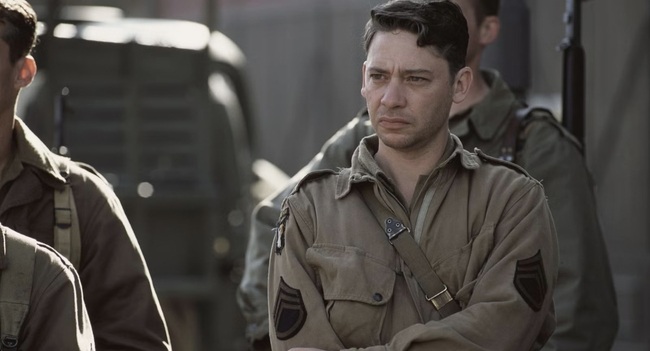
There is a fantastic war drama made for HBO and still available on the streamer that gives harrowing insights into another HBO product’s best episode. Band of Brothers might be one of the best things that HBO has ever produced, standing out among miniseries, historical fiction, and just TV shows in general.
Based on the non-fiction book by Stephen E. Ambrose, Band of Brothers is the poster child for HBO’s competency when it comes to miniseries. Everyone knows HBO has mastered the miniseries and the TV series, but what it never gets enough credit for is its small but impressive suite of original movies.
There are some excellent films in its library, and one of the best is Conspiracy, a 2001 war drama film that depicts the Wannsee Conference, a conference so secret that the participants attempted to destroy all evidence that it even happened. The movie is adapted from the only surviving copy of the meeting’s minutes.
Frank Pierson directs Conspiracy.
The Wannsee Conference was a clandestine conference held by members of the Nazi Party in 1942. The point of the meeting was to determine the solution to the “Jewish Question”. It was at this conference that key members of the Nazi Party outlined the plans for the Holocaust.
With an ensemble that includes Kenneth Branagh, Stanley Tucci, and Colin Firth, Conspiracy is a chamber drama that takes place entirely in one house, and almost entirely in one room. It’s an engrossing film about procedure and the callous inhumanity of genocide, and it gives even more dramatic weight to the Band of Brothers episode that also wrestles with the Holocaust.
Conspiracy Is A Powerful, Compelling Film That Is Careful Not To Humanize Its Characters

Conspiracy starts and ends with the conference. High-ranking members of the Nazi Party are invited by Reinhard Heydrich (Brannagh) to a beautiful estate for the meeting. In front of a luxurious lunch spread complete with cigars, brandy, and wine, Heydrich explains the nagging issue plaguing Nazi Germany.
The fate of the Jews in Germany and beyond is at hand, and members of the SS, who are fervent in their animosity, and more bureaucratic members of the Nazi Party, who are not as animated in their hatred but no less prejudiced, debate the practicality, implementation, and right to begin what would later become known as the Holocaust.
Conspiracy does not humanize its characters. It doesn’t apologize for the men at that table, even though some are presented in a more sympathetic light than others. What Conspiracy does is show the cold calculus, inhuman legal arguments, cowardly obsequiousness, and internalized hatred that allow for something like what we see in Band of Brothers episode 9, “Why We Fight”.
The Band Of Brothers Episode “Why We Fight” Is A Moving Look At One Of The Worst Events In History

“Why We Fight” is arguably the best episode of Band of Brothers. The episode features Nixon’s (Ron Livingston) burgeoning alcoholism, and the winding down of the war as Hitler kills himself and German soldiers surrender in the hundreds of thousands. At the center of “Why We Fight”, however, is Easy Company’s discovery of the Kaufering concentration camp.
It’s a horrible scene, as the Allied soldiers walk into the camp, not comprehending what they are seeing. As they make their way through, they begin to understand what they’ve stumbled upon, and learn that it’s just the tip of the iceberg. Later, Easy forces the German populace of the nearby town to bury the bodies there.
The citizens claim they had no idea what was happening in their backyard, and you wonder how that could be. You wonder, even if that’s untrue and they knew, how they could stomach it. Conspiracy shows how, by turning human lives into numbers on a spreadsheet, and viewing a people’s existence not as a right, but as a blemish to be wiped away.